Exponential Moving Average (EMA) Indicator In Stock Trading
)
Table of Contents
Key Takeaways
What is Exponential Moving Average (EMA)?
How Exponential Moving Average (EMA) Works
How Important is Exponential Moving Average (EMA) in Technical Analysis?
Formula for Exponential Moving Average (EMA)
How To Calculate EMA?
Applications of the Exponential Moving Average
What Are The Advantages Of EMA?
What Are The Disadvantages Of EMA?
Bottom Line
FAQs
The exponential moving average (EMA) is a powerful technical indicator that helps traders identify trends. Unlike simple averages, it gives more weight to recent price data. This makes EMA responsive to current market conditions. Traders use this tool to spot opportunities in stock price movements. Understanding EMA can transform your approach to technical analysis and closing price evaluation. Whether you're new to trading or refining your strategy, mastering EMA opens doors to better market timing. This comprehensive guide breaks down everything from basic definitions to advanced applications.
Key Takeaways
- EMA Definition and Function: The exponential moving average is a technical indicator that emphasizes recent price data over historical data, making it more responsive than simple moving averages to current market conditions
- Calculation Method: EMA uses a specific formula with a multiplier based on your chosen time period, building each new value on previous calculations for smooth, continuous tracking
- Trend Identification: Traders use EMA to spot upward and downward trends by observing when prices cross above or below the moving average line, with rising EMAs confirming bullish momentum
- Support and Resistance: EMAs create dynamic support and resistance levels that move with the market, providing traders with adaptive entry and exit points
- Multiple Time Frames: Different EMA periods serve various purposes - 12-day for short-term, 50-day for intermediate, and 200-day for long-term trend analysis
- Advantages vs Limitations: While EMA responds quickly to price changes and works across all time frames, it remains a lagging indicator that can produce false signals in sideways markets
- Best Practices: Combine EMA with other technical indicators like volume and momentum oscillators for comprehensive analysis and more reliable trading signals
What is Exponential Moving Average (EMA)?
)
The EMA is a technical indicator that tracks stock price over time. It's one of the most popular lag indicators in trading. Unlike simple moving average calculations, EMA emphasizes recent trading day activity.
Think of EMA as a smart assistant. It remembers past prices but pays closer attention to what happened yesterday. This technical chart indicator smooths out price fluctuations while staying current. Traders rely on it because markets move fast.
The EMA places greater weight on recent data points. If a stock jumped 5% today, EMA notices immediately. A simple moving average (SMA) treats all days equally. This difference matters when you need quick signals.
Professional traders use exponential moving averages for multiple time frames. A 12-day EMA tracks short-term movements. A 26-day EMA captures medium trends. The 200-day EMA shows long-term direction. Each serves a specific purpose in analysis.
Most trading platforms display EMA as a blue line on charts. It flows through price bars like a river. When prices stay above the EMA, it suggests strength. Prices below often signal weakness. This visual simplicity makes EMA accessible to beginners.
How Exponential Moving Average (EMA) Works
)
The exponential moving average works by applying a multiplier to recent data. This multiplier ensures new price movements influence the average more than historical average data. The calculation creates a smooth line that follows price fluctuations closely.
Here's the magic: EMA adjusts itself constantly. Each new closing price updates the entire calculation. Older data points fade gradually but never disappear completely. This creates a responsive yet stable indicator.
The weighting process distinguishes EMA from other moving average indicators. Recent price data might represent 20% of the total calculation. Yesterday's data gets slightly less weight. Last week's prices matter even less. This exponential decay gives the indicator its name.
How Important is Exponential Moving Average (EMA) in Technical Analysis?
EMA generates reliable buy and sell signals for intraday traders. When price crosses above a rising EMA, it often signals buying opportunity. The opposite suggests selling. These crossovers help traders time their trading positions effectively.
Technical analysis relies heavily on EMA for trend confirmation. A rising EMA confirms upward momentum. A falling EMA validates downward pressure. Traders combine multiple EMAs to spot trend changes early.
The indicator excels at filtering market noise. Daily price swings can confuse traders. EMA smooths these movements into clear patterns. This clarity helps both beginners and professionals make better decisions based on price action.
Formula for Exponential Moving Average (EMA)
The EMA formula combines three elements: today's price, yesterday's EMA, and a multiplier. Understanding this formula helps traders customize their analysis. Here's the basic structure:
EMA = (Current Price × Multiplier) + (Previous EMA × (1 - Multiplier))
The multiplier determines EMA weighting for recent data points.
Calculate it using this formula:
Multiplier = 2 ÷ (Time Period + 1)
For a 10-day EMA, the multiplier equals 2 ÷ 11 = 0.1818 (18.18%). This means today's price contributes 18.18% to the final value. The remaining 81.82% comes from previous calculations.
The formula creates exponential smoothing. Each calculation builds on the previous one. This recursive nature makes EMA responsive yet stable. Sudden price spikes affect it less than simple moving average indicators.
Don't worry if math isn't your strength. Trading platforms calculate EMA automatically. Understanding the concept matters more than manual computation. Focus on interpreting the results rather than crunching numbers.
How To Calculate EMA?
Calculating exponential moving average involves three main steps. First, calculate the simple moving average (SMA) for your initial EMA value. Second, compute the multiplier. Third, apply the EMA formula for each subsequent day.
Step 1: Calculate Initial SMA Add closing prices for your chosen period. Divide by the number of days. For a 10-day period with prices summing to $500, SMA = $500 ÷ 10 = $50.
Step 2: Calculate the Multiplier Use the formula: 2 ÷ (Period + 1). For 10 days: 2 ÷ 11 = 0.1818.
Step 3: Apply EMA Formula Daily Current EMA = (Today's Price × 0.1818) + (Yesterday's EMA × 0.8182).
Let's say today's price is $52 and yesterday's EMA was $50:
- New EMA = ($52 × 0.1818) + ($50 × 0.8182)
- New EMA = $9.45 + $40.91 = $50.36
What Is An Example Of A 200-Day Exponential Moving Average (EMA) Calculation?
The 200-day exponential moving average tracks long-term trends. Its multiplier equals 2 ÷ 201 = 0.00995 (about 1%). This small multiplier makes it stable and slow-moving.
Imagine tracking Apple stock over 200 days. Initial prices average $150. Today's price jumps to $160. The calculation becomes:
- New EMA = ($160 × 0.00995) + ($150 × 0.99005)
- New EMA = $1.59 + $148.51 = $150.10
Notice how the 10-point jump barely moved the EMA. This stability helps identify major trend changes. When prices finally push the 200-day EMA higher, it signals strong momentum.
What Is An Example Of A 50-Day Exponential Moving Average (EMA) Calculation?
The 50-day EMA balances responsiveness with stability. Its multiplier is 2 ÷ 51 = 0.0392 (3.92%). This medium-term indicator captures intermediate trends effectively.
Using the same example with $150 average and $160 current price:
- New EMA = ($160 × 0.0392) + ($150 × 0.9608)
- New EMA = $6.27 + $144.12 = $150.39
The 50-day EMA moved more than the 200-day version. Yet it remains stable enough to filter daily noise. Many traders combine both for comprehensive analysis.
Applications of the Exponential Moving Average
Exponential moving averages serve multiple purposes in trading. Smart investors use them as dynamic tools rather than static lines. Understanding these applications improves your technical analysis significantly.
1. Highlighting Trends
EMA excels at revealing price directions and price trends. An upward trend shows consistent higher prices over time. The EMA line slopes upward, confirming bullish momentum. Traders buy when prices stay above rising EMAs.
Watch how EMA responds during trends. In strong uptrends, prices rarely touch the EMA. They bounce off it like a trampoline. This behavior confirms trend strength and helps traders stay positioned correctly.
Multiple EMAs create powerful trend indicators. The 20-day EMA shows short-term direction. The 50-day reveals intermediate trends. Together, they paint a complete picture of market movement. When all EMAs align upward, trends are strongest.
2. Support and Resistance Bands
)
)
EMAs create dynamic support levels and resistance levels through price action. Unlike fixed horizontal lines, these levels move with the market. This adaptability makes them invaluable for active traders.
During uptrends, EMAs act as support. Prices often bounce off them before continuing higher. Traders place buy orders near these levels. The 50-day EMA provides particularly strong support in trending markets.
In downtrends, EMAs become resistance. Prices struggle to break above them. Short sellers use these levels to enter positions. The 200-day EMA often acts as major resistance during bear markets.
These support and resistance levels strengthen with testing. Each successful bounce reinforces the level's importance. Traders gain confidence when EMAs hold repeatedly. Breaking these levels signals potential trend changes.
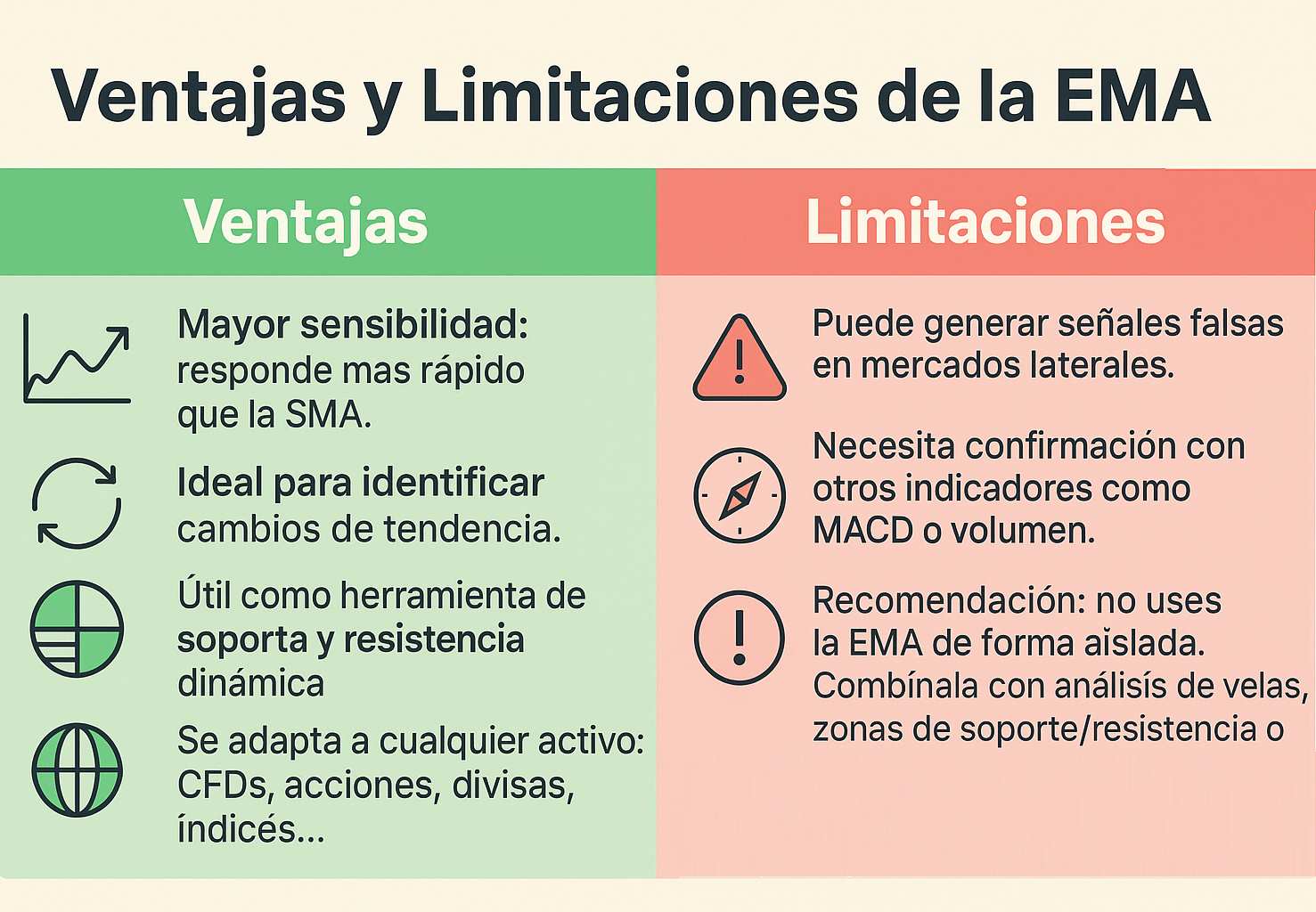
What Are The Advantages Of EMA?
The exponential moving average offers several benefits for tracking price fluctuations in intraday trading. Understanding these advantages helps you use EMA effectively across different market trends and time frames.
- Quick Response to Price Changes EMA reacts faster to recent price movements than simple averages. This responsiveness, due to giving more weight to recent data, helps traders catch trends early. You'll spot opportunities before slower indicators signal. Quick reactions matter in volatile markets.
- Smooth Trend Identification Despite its responsiveness, EMA maintains smooth curves. It filters minor fluctuations while preserving important movements. This balance helps identify genuine trends versus temporary spikes. Clear signals reduce false trades.
- Versatility Across Time Frames EMA works effectively on any chart period. Scalpers use 5-minute EMAs for quick trades. Swing traders prefer daily EMAs. Long-term investors watch weekly versions. One indicator serves all trading styles.
- Easy Visual Interpretation EMA creates clear visual signals on charts. Crossovers are obvious. Trend directions appear instantly. Support and resistance show clearly. This simplicity helps beginners learn quickly while providing depth for experts.
What Are The Disadvantages Of EMA?
Despite its popularity, exponential moving average has limitations. These disadvantages can generate conflicting signals during certain market conditions. Understanding these weaknesses prevents costly mistakes in your trading sessions.
- Lagging Indicator Nature EMA remains a lagging indicator despite its responsiveness. It can't predict future prices. Signals arrive after moves begin. This delay causes late entries during sharp reversals. Traders must accept this inherent limitation.
- Whipsaws in Ranging Markets Sideways markets create multiple false signals. Prices cross EMAs repeatedly without establishing trends. These whipsaws generate losses for trend-following strategies. Price gaps make the problem worse during earnings season.
- Over-Reliance Risk Some traders depend too heavily on EMA alone. No single indicator provides complete analysis. EMAs miss important factors like volume and momentum. Remember: 'EMA is a compass, not a GPS' - it shows direction but won't navigate every turn. Successful trading requires multiple confirmation tools beyond moving averages.
Bottom Line
The exponential moving average (EMA) stands as an essential tool for modern traders. Its ability to emphasize recent prices while maintaining historical context creates unique analytical value. Smart traders combine EMA with other technical indicators for comprehensive market analysis.
Success with EMA requires practice and patience. Start with longer time periods to understand basic concepts. Graduate to shorter frames as your skills develop. Remember that EMA works best when price action shows clear trending markets. Combine it with momentum indicators during ranges.
The moving average convergence divergence (MACD) indicator actually uses two EMAs in its calculation. This popular momentum oscillator demonstrates how EMAs work together to generate powerful signals. Understanding individual EMAs helps you master more complex indicators.
Most importantly, use EMA as part of a complete trading strategy. Let it guide your decisions without dictating them. The exponentially weighted moving average provides insights, not guarantees. Respect its signals while maintaining disciplined risk management. Consider paper trading first to build confidence with real market conditions.
Ready to apply EMA in real trading? Open a demo account and practice identifying trends. Watch how different EMAs interact with price movements. Your understanding will deepen through hands-on experience. The market rewards those who master their tools.
FAQs
Is The EMA Better Than The SMA Day Trading?
EMA typically outperforms simple moving average (SMA) for day trading due to faster response times. It catches momentum shifts earlier, giving traders an edge. However, this sensitivity can create more false signals in choppy markets.
What Is a Good Exponential Moving Average?
The best exponential moving average depends on your trading style and time frame. Popular choices include 9-day for short-term, 21-day for swing trading, and 50-day for position trading. Test different periods to find what suits your strategy.
What Time Frames Are Commonly Used For EMAs?
Common EMA time periods include 12 and 26 days for MACD calculations, 50 days for intermediate trends, and 200 days for long-term analysis. Intraday traders often use 5, 10, and 20-period EMAs on minute charts.
Is EMA The Same as EWMA?
Yes, EMA and exponentially weighted moving average (EWMA) refer to the same concept. Both terms describe the same mathematical calculation that weights recent data more heavily. Financial markets prefer "EMA" while statisticians use "EWMA."
How Do You Read Exponential Moving Averages?
Read exponential moving averages by observing their slope and relationship to price. Rising EMAs signal uptrends, falling EMAs indicate downtrends. Price crossing above EMA suggests buying opportunities, while crossing below hints at selling points.