EUR/USD Trading: Master the World's Most Liquid Forex Pair in Germany
)
What is EUR/USD and Why It's the King of Forex Trading
Understanding EUR/USD Market Dynamics
Best Times to Trade EUR/USD
Risk Management for EUR/USD Trading in Germany
Technical Analysis Strategies for EUR/USD Trading
Choosing the Best Forex Broker for EUR/USD Trading in Germany
Common EUR/USD Trading Mistakes and How to Avoid Them
Getting Started with EUR/USD Trading: A Step-by-Step Guide
Conclusion: Your Path to EUR/USD Trading Success
Frequently Asked Questions
The EUR/USD currency pair stands as the undisputed heavyweight of the foreign exchange market, commanding over $1.5 trillion in daily trading volume and representing roughly 28% of all global forex activity.
For traders based in Germany this pair offers a unique home-court advantage. The Euro and the US Dollar are the world's two most widely held reserve currencies. Together, they create a dynamic trading instrument shaped by the monetary policies of the European Central Bank and the Federal Reserve. Macroeconomic data releases and geopolitical developments on both sides of the Atlantic further drive the pair's price action.
This guide covers everything from market dynamics and trading sessions to technical analysis strategies, risk management frameworks, and the regulatory landscape under BaFin regulation that governs forex trading in Germany.
Key Takeaways
- Market Dominance: EUR/USD is the most liquid currency pair globally, with daily volume exceeding $1.5 trillion
- Central Bank Impact: ECB and Federal Reserve interest rate decisions are the single most powerful drivers of EUR/USD price action
- Optimal Trading Times: The London–New York overlap (13:00–17:00 GMT) delivers peak liquidity and volatility
- Risk Management First: Position sizing of 1–2% risk per trade is essential for capital preservation
- German Regulatory Framework: BaFin oversight and MiFID II compliance protect German forex traders
What is EUR/USD and Why It's the King of Forex Trading
EUR/USD trading involves speculating on the exchange rate between the Euro and the US Dollar. These are two currencies that together underpin the majority of global trade and financial reserves.
With a daily volume surpassing $1.5 trillion, this currency pair accounts for approximately 28% of all forex market turnover, making it the most actively traded instrument in the world. That extraordinary liquidity means tighter spreads (typically 0.5–1.5 pips with quality brokers), faster execution, and more reliable technical patterns compared to virtually any other financial instrument.
The pair's dominance stems from the sheer economic weight behind each currency. The Euro represents the collective output of 20 Eurozone nations, managed by the European Central Bank in Frankfurt. The US Dollar, managed by the Federal Reserve, remains the world's primary reserve currency.
Interest rate differentials between these two central banks serve as the most influential driver of EUR/USD price movements. When the Fed tightens monetary policy faster than the ECB, the Dollar strengthens and EUR/USD falls, and vice versa. For German traders, EUR/USD offers the advantage of trading a pair where one half is deeply familiar territory.
Interpreting the EUR/USD Price
In the EUR/USD currency pair, the Euro is the base currency and the US Dollar is the quote currency. The price reflects how many US Dollars are needed to purchase one Euro.
When the exchange rate moves from 1.0500 to 1.0600, the Euro has strengthened against the Dollar, each Euro now buys one cent more in USD. A single pip (percentage in point) equals 0.0001, so that move represents a 100-pip gain for a long position. Conversely, a price drop from 1.0500 to 1.0400 signals Dollar strength and Euro weakness.
EUR/USD Price Movement:
- Price rises → Euro strengthens / Dollar weakens
- Price falls → Euro weakens / Dollar strengthens
History of the EUR/USD
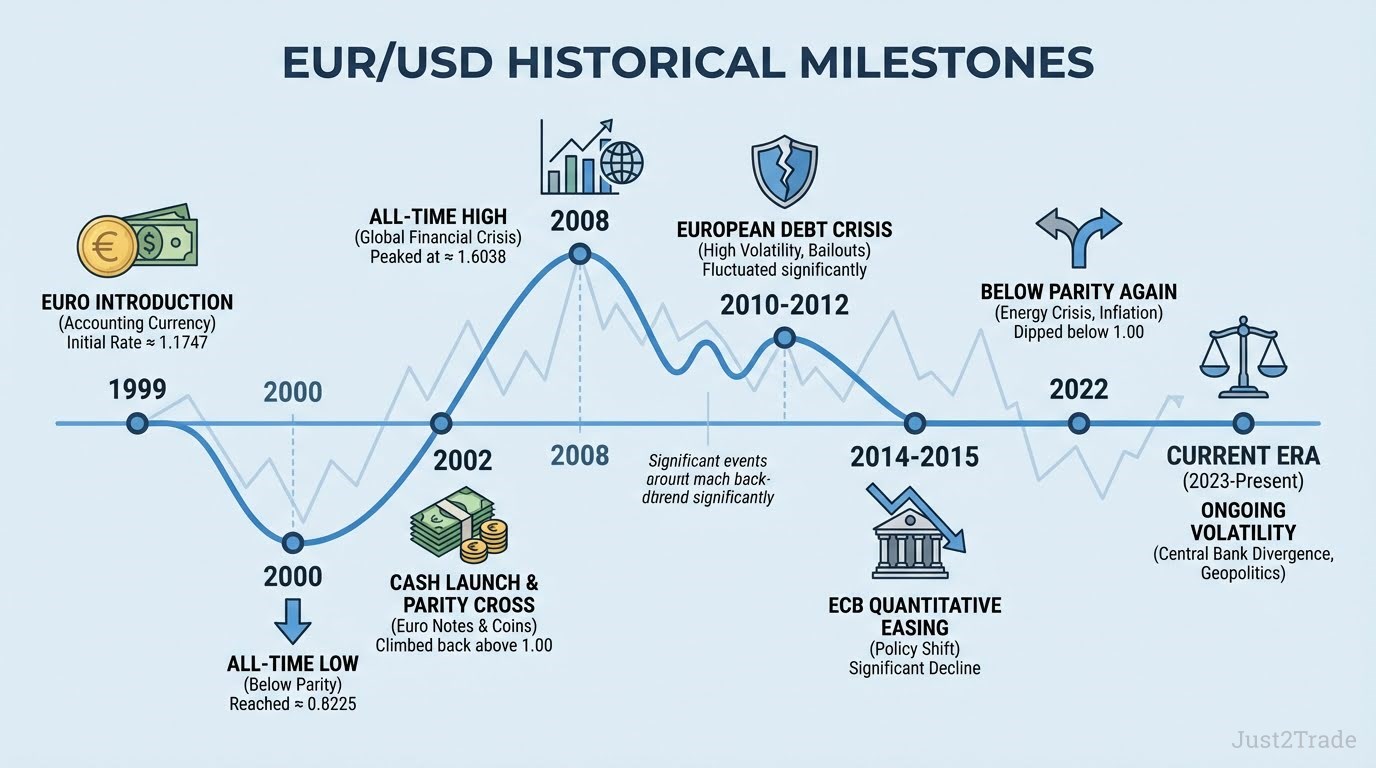)
The Euro was introduced as an electronic currency on January 1, 1999, with the EUR/USD pair beginning its life at approximately 1.1795. The early years were challenging for Euro credibility. The pair plunged to its all-time low of roughly 0.8230 in October 2000 as markets questioned the new currency's viability.
As the Eurozone stabilized and the European Central Bank established its authority, EUR/USD began a sustained multi-year rally. By July 2008, the pair had reached its all-time high of approximately 1.6038, driven by the global financial crisis and a broad exodus of capital from the US Dollar.
Since then, EUR/USD has traded in a broad range between 0.95 and 1.25. Several major events shaped this period: the European sovereign debt crisis (2010–2012), divergent monetary policies, and the COVID-19 pandemic. The energy shock following geopolitical events in 2022 pushed the pair briefly below parity for the first time in two decades.
Understanding EUR/USD Market Dynamics
EUR/USD price movements are the product of a complex interplay between economic indicators, central bank policies, geopolitical events, and market sentiment. Unlike equity markets, where individual company fundamentals dominate. This currency pair responds primarily to the relative economic health of the Eurozone versus the United States.
The most critical driver remains the interest rate differential between the ECB and the Federal Reserve. When one central bank raises rates while the other holds steady or cuts, capital flows toward the higher-yielding currency. This dynamic creates sustained directional moves in the exchange rate.
Beyond rates, EUR/USD responds to economic data releases. Non-Farm Payrolls (NFP) from the US, Eurozone inflation readings, GDP figures, and purchasing managers' index (PMI) data can all trigger significant intraday moves of 50 to 150 pips.
Market sentiment and risk appetite also play a role. During periods of global uncertainty, the US Dollar often benefits from safe-haven flows, pushing EUR/USD lower. Conversely, risk-on environments tend to weaken the Dollar as capital moves into higher-yielding or growth-sensitive assets. Understanding these dynamics forms the foundation of any successful EUR/USD trading strategy.
Critical Economic Indicators for EUR/USD
Economic indicators act as the fundamental fuel behind EUR/USD volatility. The following table ranks the highest-impact data releases by their typical effect on the pair:
| Indicator |
Region |
Release Frequency |
Typical EUR/USD Impact |
| Non-Farm Payrolls (NFP) |
US |
Monthly (first Friday) |
High — 50–100+ pip moves |
| CPI / Inflation Data |
US & Eurozone |
Monthly |
High — shapes rate expectations |
| Central Bank Rate Decisions |
ECB / Fed |
~6 weeks |
Very High — sets directional bias |
| GDP Growth |
US & Eurozone |
Quarterly |
Medium-High |
| PMI (Manufacturing & Services) |
US & Eurozone |
Monthly |
Medium — early growth signals |
| Retail Sales |
US & Eurozone |
Monthly |
Medium |
| Employment Data (Eurozone) |
Eurozone |
Monthly |
Medium |
Strong US NFP figures, for example, typically strengthen the Dollar, pushing EUR/USD lower by 50–100 pips in the immediate aftermath. Conversely, higher-than-expected Eurozone inflation can lift EUR/USD by reinforcing expectations of ECB tightening.
The Central Bank Factor: ECB vs. Federal Reserve
)
The European Central Bank and the Federal Reserve wield enormous influence over EUR/USD through their interest rate decisions and forward guidance. Policy divergence between these two institutions creates some of the most tradeable opportunities in forex.
When the Fed signals rate hikes while the ECB maintains an accommodative stance, EUR/USD typically enters sustained downtrends. The widening interest rate differential favors the US Dollar, drawing capital away from the Euro.
The reverse scenario works the same way. ECB hawkishness combined with Fed dovishness pushes EUR/USD higher as the differential shifts in favor of the Euro.
Traders closely monitor:
- "Hawkish" language (emphasis on inflation risks, economic strength) → favors the respective currency
- "Dovish" language (focus on economic risks, need for support) → weakens the respective currency
- Forward guidance shifts (changes to projected rate paths) → often move EUR/USD more than actual rate changes
- Quantitative easing/tightening programs → affect long-term bond yields and currency flows
Interpreting central bank communications in real time is a critical skill for EUR/USD traders. Press conferences following rate decisions frequently generate the largest single-day moves of the year.
Best Times to Trade EUR/USD
)
The forex market operates 24 hours a day. Trading activity is spread across three major sessions: Asian, European, and North American. EUR/USD does not behave uniformly throughout these windows. Liquidity and volatility vary dramatically, and choosing the right trading window can make the difference between clean price action and frustrating, choppy markets.
The European session (08:00–17:00 GMT) is when EUR/USD truly comes alive, driven by institutional activity from London and Frankfurt. The morning hours (08:00–12:00 GMT) often produce strong trending moves as European banks and funds establish positions.
However, the London–New York overlap (13:00–17:00 GMT) represents the single best window for EUR/USD trading. This is when both sessions operate simultaneously, delivering peak liquidity, the tightest spreads, and the highest average pip range.
The Asian session (00:00–08:00 GMT) tends to produce range-bound, lower-volatility conditions for EUR/USD, which can suit range-trading strategies but generally frustrates trend followers.
For German traders (CET/CEST), the optimal schedule aligns conveniently with normal working hours. The European session opens at 09:00 CET, and the overlap window runs from 14:00 to 18:00 CET.
| Session |
Time (GMT) |
EUR/USD Characteristics |
Best For |
| Asian |
00:00–08:00 |
Low volatility, range-bound |
Range trading, preparation |
| European |
08:00–17:00 |
High volatility, trending moves |
Day trading, breakout strategies |
| London–NY Overlap |
13:00–17:00 |
Peak liquidity, widest range |
All strategies, news trading |
| US Afternoon |
17:00–21:00 |
Declining volatility |
Position management |
Seasonal Patterns and Trends in EUR/USD
EUR/USD exhibits recurring seasonal tendencies that, while not guaranteed, can inform broader trading decisions.
Summer months (July–August) typically see reduced volatility as institutional traders take holidays. This phenomenon is known as the "summer doldrums" that occurs in approximately 70% of years.
September through November historically delivers some of the strongest trending moves as institutional desks return and major central bank policy meetings cluster together.
December brings year-end positioning flows and portfolio rebalancing, occasionally creating sharp moves in the final two weeks before liquidity drops around the holidays.
April can see notable flows tied to tax-related repatriation, particularly from the US side. These seasonal patterns provide useful context for adjusting expectations around position sizing and volatility targets, though they should never serve as standalone trading signals.
Risk Management for EUR/USD Trading in Germany
Risk management is the single most important determinant of long-term survival in EUR/USD trading. The pair's moderate to high volatility profile demands a disciplined, systematic approach to capital protection. This is especially true during economic data releases and central bank announcements.
German traders benefit from strong regulatory safeguards under BaFin, including negative balance protection and leverage caps (30:1 maximum for major pairs like EUR/USD under ESMA rules). However, regulatory protection alone is insufficient. A robust risk management framework should include:
- Position sizing discipline — Risk no more than 1–2% of total account equity on any single trade
- Stop-loss placement — Set stops beyond the EUR/USD average daily range (typically 60–80 pips) to avoid noise-driven exits
- Risk-reward requirements — Target a minimum 1:2 risk-to-reward ratio before entering any position
- Correlation awareness — Avoid stacking multiple positions on highly correlated pairs (e.g., EUR/USD long + GBP/USD long effectively doubles exposure)
- News event management — Reduce position size or stand aside during high-impact releases like NFP or ECB decisions
- Drawdown limits — Establish a maximum daily and weekly drawdown threshold (e.g., 5% weekly) to prevent emotional overtrading
- Leverage control — Use significantly less than the maximum available leverage; effective leverage of 5:1–10:1 is more appropriate for most traders
BaFin-regulated forex brokers in Germany must provide transparent reporting of trading costs and execution quality. This adds an additional layer of protection for traders who select their broker wisely.
Technical Analysis Strategies for EUR/USD Trading
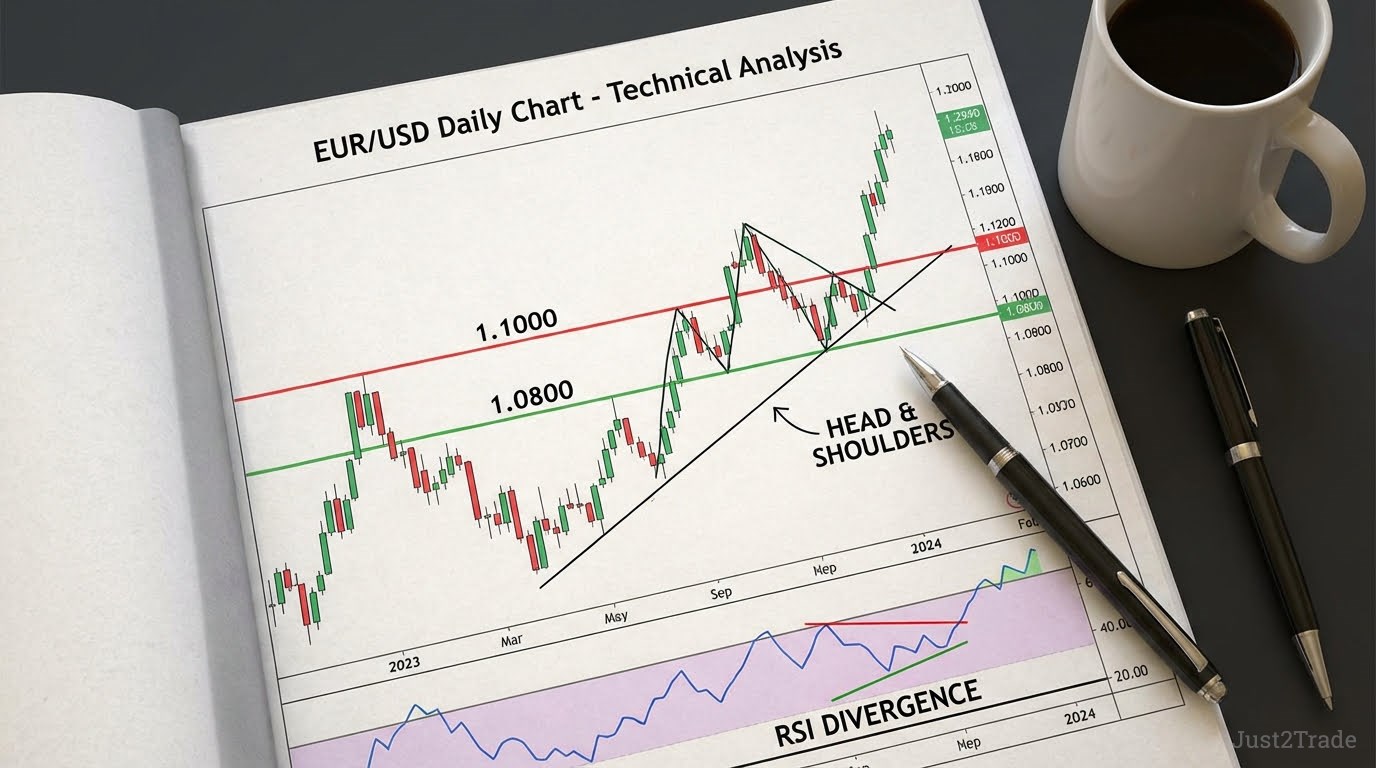
Technical analysis forms the backbone of most successful EUR/USD trading strategies. The pair's deep liquidity makes it particularly responsive to chart-based patterns and indicators.
Unlike less liquid pairs where technical levels can be easily broken by thin order flow, EUR/USD's massive volume means that support and resistance levels, trendlines, and indicator signals tend to hold with greater reliability.
A well-rounded technical approach for EUR/USD typically incorporates three elements: trend identification, signal generation, and confirmation. For trend identification, moving average crossovers work effectively on the 4-hour and daily charts.
Among the most popular combinations are the 20-period and 50-period exponential moving averages (EMA). When the 20 EMA crosses above the 50 EMA, it signals a bullish market trend; the reverse indicates bearish conditions.
For signal generation, combining the Relative Strength Index (RSI) with support and resistance levels creates high-probability entry points. RSI readings above 70 at established resistance suggest overbought conditions and potential reversals, while readings below 30 at support indicate oversold conditions. Adding volume analysis and candlestick patterns as confirmation filters further improves accuracy.
Timeframe selection matters significantly. Trend identification is an essential part of trading EUR/USD. Moving average crossovers are a reliable tool for this task, especially on the 4-hour and daily charts. The 20-period and 50-period exponential moving averages (EMA) are particularly effective.
Price Action Techniques for EUR/USD
Moving average crossovers work effectively for trend identification on the 4-hour and daily charts. The 20-period and 50-period exponential moving averages (EMA) are particularly useful for this purpose.
The most reliable price action patterns for EUR/USD include:
Pin bar rejections at major support/resistance — Historically show approximately 65% reversal rate when occurring at psychological round numbers
Bullish/bearish engulfing patterns — Particularly effective on the daily chart at the confluence of moving average support and horizontal levels
Inside bars — Useful for breakout trading during consolidation phases, especially ahead of major data releases
Doji candles at extremes — Signal indecision and potential reversal at key levels, especially when confirmed by RSI divergence
The most critical factor in price action trading is context. A pin bar forming at a well-established support level within a broader uptrend carries far more weight than the same pattern appearing in the middle of a range. Aligning price action signals with the prevailing market trend dramatically improves success rates.
Currency Correlations with EUR/USD
EUR/USD does not trade in isolation. It maintains measurable correlations with other major instruments that can be used for trade confirmation and risk management.
Trend identification is an essential part of trading EUR/USD. Moving average crossovers are a reliable tool for this task, especially on the 4-hour and daily charts. The 20-period and 50-period exponential moving averages (EMA) are particularly effective.
GBP/USD maintains a positive correlation of roughly +0.70 with EUR/USD, reflecting shared exposure to US Dollar movements. When EUR/USD moves higher but GBP/USD fails to follow, the divergence can signal a weakening move that may soon reverse.
EUR/USD also shows a moderate positive correlation with gold prices, as both assets tend to benefit from US Dollar weakness. These correlations can serve as powerful confirmation tools. If a EUR/USD breakout higher is accompanied by a simultaneous USD/CHF breakdown and rising gold prices, traders can have substantially more conviction in the move.
Choosing the Best Forex Broker for EUR/USD Trading in Germany
Selecting the right forex broker is a foundational decision for EUR/USD traders in Germany. The combination of regulatory compliance, competitive spreads, reliable execution, and suitable platform offerings determines the quality of every trading experience.
Under German and EU regulations, brokers serving German clients must comply with BaFin regulation and MiFID II directives, ensuring segregated client funds, negative balance protection, and transparent pricing.
For EUR/USD specifically, the most critical broker selection criteria center on trading costs. Competitive brokers offer EUR/USD spreads in the range of 0.5 to 1.5 pips for standard accounts. Some ECN or raw spread accounts deliver even tighter pricing, starting from 0.0 to 0.3 pips. However, these accounts typically charge a separate commission.
Execution speed is another important factor to consider. During volatile events such as NFP releases, slippage can vary significantly between brokers. These differences can have a noticeable impact on trading results.
| Criteria |
What to Look For |
Why It Matters for EUR/USD |
| Regulation |
BaFin / CySEC / FCA (EU-compliant) |
Legal protection, fund segregation |
| EUR/USD Spread |
0.5–1.5 pips (standard); 0.0–0.3 pips (ECN) |
Direct impact on profitability |
| Execution Speed |
Under 50ms average |
Critical during news events |
| Platform Options |
MetaTrader 4/5, TradingView integration |
Analysis and automation capability |
| Leverage |
Up to 30:1 (ESMA regulated) |
Regulatory maximum for retail |
| Deposit/Withdrawal |
EUR-denominated accounts, SEPA transfers |
Avoid conversion fees |
| Customer Support |
German-language support availability |
Resolving issues efficiently |
EUR/USD on Different Trading Platforms
The two most widely used platforms for EUR/USD analysis and execution — MetaTrader 4 and TradingView — serve complementary purposes.
MetaTrader 4 (MT4) remains the industry standard for execution-focused trading. Its strengths for EUR/USD include:
- Expert Advisors (EAs) for automated trading strategies
- Extensive library of built-in and custom indicators
- Direct broker integration for one-click execution
- Low system resource requirements
TradingView excels in charting and analysis capabilities:
- Superior multi-timeframe charting with intuitive interface
- Community-driven indicator library and social trading insights
- Multi-broker connectivity for execution directly from charts
- Cloud-based access from any device without installation
Many serious EUR/USD traders use TradingView for analysis and chart preparation, then execute trades through MetaTrader 4 connected to their preferred broker. This combination leverages the strengths of both platforms.
Is Forex Trading Legal in Germany?
Forex trading is fully legal in Germany. The regulatory framework is overseen by BaFin, which stands for Bundesanstalt für Finanzdienstleistungsaufsicht. German regulations are also aligned with EU-wide MiFID II directives, ensuring a comprehensive level of oversight.
Key regulatory considerations for German forex traders include:
- Broker authorization: The broker must hold authorization from BaFin or an equivalent EU regulator (e.g., CySEC, FCA) with passporting rights into Germany
- Leverage limits: Maximum 30:1 for major pairs like EUR/USD under ESMA retail client rules
- Negative balance protection: Mandatory for all EU-regulated retail accounts
- Tax obligations: Profits from forex trading are subject to capital gains tax (Abgeltungssteuer) at a flat rate of approximately 25% plus solidarity surcharge—consult a qualified tax advisor for individual circumstances
- Reporting requirements: Brokers do not automatically withhold German taxes for non-German entities, making self-reporting essential
Common EUR/USD Trading Mistakes and How to Avoid Them
Even the most liquid and technically clean currency pair in the world cannot protect traders from self-inflicted errors. The following mistakes appear consistently among EUR/USD traders, from beginners to experienced participants:
- Overleveraging because of tight spreads — EUR/USD's low trading costs tempt traders into oversized positions. Solution: Calculate position size based on stop-loss distance and 1–2% account risk, regardless of spread costs.
- Ignoring central bank announcements — Trading through ECB or Federal Reserve decisions without adjusting exposure is a common source of catastrophic losses. Solution: Maintain an economic calendar and either reduce positions or stand aside during high-impact events.
- Trading during low-liquidity periods — Entering EUR/USD positions during the Asian session often results in choppy, directionless price action. Solution: Concentrate activity during the European session and London–New York overlap.
- Chasing news spikes without confirmation — Jumping into trades immediately after data releases leads to poor fills and frequent reversals. Solution: Wait 15–30 minutes post-release for the initial spike to settle before seeking confirmed setups.
- Abandoning a trading strategy during drawdowns — Switching strategies after a few losing trades destroys any statistical edge. Solution: Evaluate strategy performance over a minimum of 50–100 trades before making adjustments, and document every trade in a journal.
Getting Started with EUR/USD Trading: A Step-by-Step Guide
For those ready to begin the EUR/USD trading journey, a structured approach dramatically improves the probability of long-term success. Rushing into live trading without adequate preparation is the single most common path to early failure.
- Build foundational knowledge — Study EUR/USD market dynamics, learn how economic indicators and central bank policies drive the exchange rate, and understand basic technical analysis concepts
- Select a regulated broker — Choose a BaFin-compliant or EU-regulated forex broker with competitive EUR/USD spreads, reliable execution, and platform options like MetaTrader 4 or TradingView integration
- Develop a simple trading strategy — Start with one approach (e.g., trend following with moving averages on the 4-hour chart) rather than trying to master everything simultaneously
- Implement risk management rules — Define position sizing (1–2% risk per trade), stop-loss methodology, and daily drawdown limits before placing any trades
- Practice on a demo account — Spend a minimum of three months trading the strategy on a demo account, tracking results in a detailed journal to evaluate performance over at least 50–100 trades
- Transition to a small live account — Begin with the minimum feasible capital, understanding that the psychological transition from demo to live trading introduces new challenges around discipline and emotional control
- Scale gradually — Increase position sizes only after demonstrating consistent execution of the strategy and risk management rules over an extended period
The learning curve varies, but most traders who ultimately succeed report needing 6–12 months of consistent practice before achieving reliable results.
Conclusion: Your Path to EUR/USD Trading Success
EUR/USD remains the ideal currency pair for traders seeking deep liquidity, tight spreads, and technically responsive price action. No other forex instrument is traded more actively than EUR/USD.
Traders have access to an extensive selection of analysis tools and educational resources dedicated to this pair. For these reasons, EUR/USD serves as the natural starting point for both beginners and experienced traders in Germany.
Trading EUR/USD successfully requires combining several key disciplines. First, traders must understand how ECB and Federal Reserve policies shape long-term trends. Second, technical analysis skills are needed to time entries and exits effectively.
Most importantly, disciplined risk management is essential to protect capital during inevitable drawdown periods. These skills develop through practice, not theory alone.
Key Points Summary
- EUR/USD dominance: $1.5+ trillion daily volume with 0.5–1.5 pip spreads — unmatched liquidity
- Central bank monitoring: ECB and Fed interest rate decisions are the primary long-term drivers
- Optimal sessions: European session and London–New York overlap (14:00–18:00 CET) for German traders
- Risk management priority: 1–2% risk per trade, mandatory stop-losses, and leverage discipline
- Continuous education: Demo practice, trade journaling, and strategy refinement are ongoing processes
Starting with a demo account, refining a clear trading strategy, and committing to continuous learning are the most reliable steps toward building lasting competence in this dynamic market.
FAQ
-
What is EUR/USD trading and how does it work?
EUR/USD trading involves buying or selling the Euro against the US Dollar on the foreign exchange market. When the price rises, the Euro strengthens relative to the Dollar; when it falls, the Dollar gains strength. With over $1.5 trillion in daily volume, EUR/USD is the most liquid currency pair globally, offering tight spreads and reliable execution for traders of all styles.
-
What factors influence the EUR/USD exchange rate?
The primary drivers are interest rate differentials between the European Central Bank and the Federal Reserve, followed by key economic indicators such as Non-Farm Payrolls, CPI inflation data, and GDP growth figures. Geopolitical developments, trade balances, and broader risk sentiment also influence the exchange rate, with central bank decisions typically producing the largest and most sustained moves.
-
What are the best times to trade EUR/USD?
The London–New York overlap (13:00–17:00 GMT / 14:00–18:00 CET) delivers peak liquidity and the widest average daily range for EUR/USD. The European morning session (08:00–12:00 GMT) also produces strong trending moves. The Asian session tends to be range-bound and lower volatility, generally less favorable for trend-following strategies.
-
What are the most effective EUR/USD trading strategies?
Trend-following strategies using moving average crossovers (20/50 EMA) on the 4-hour and daily charts are widely effective for EUR/USD. Price action trading at key support and resistance levels, breakout strategies during the London open, and news-based trading around economic data releases all offer viable approaches when combined with strict risk management.
-
How do ECB and Federal Reserve decisions impact EUR/USD trading?
When the Federal Reserve raises rates or signals hawkish policy while the ECB remains dovish, EUR/USD typically declines as the interest rate differential favors the US Dollar. The reverse drives EUR/USD higher. Beyond rate changes, forward guidance language in press conferences often generates even larger moves, making central bank communication analysis essential for EUR/USD traders.