Forex Market Hours Clock: Complete Trading Session Guide 2026
 (2))
Table of Contents
Understanding the 24-Hour Forex Market Structure
Sydney Trading Session: Asia-Pacific Market Opening
Tokyo Trading Session: Asian Financial Powerhouse
London Trading Session: Global Forex Capital
New York Trading Session: Americas Financial Hub
Peak Trading Hours: Session Overlap Analysis
How to Use a Forex Market Hours Clock
Weekend Trading and Market Gaps
Daylight Saving Time Impact on Trading Sessions
Optimal Currency Pairs by Trading Session
Advanced Session Trading Strategies
Conclusion: Mastering Forex Market Timing
Frequently Asked Questions
The forex market operates continuously through four major trading sessions: Sydney (22:00-07:00 GMT), Tokyo (00:00-09:00 GMT), London (08:00-17:00 GMT), and New York (13:00-22:00 GMT). Peak trading volume occurs during the London-New York overlap (13:00-17:00 GMT), when market liquidity and volatility reach their daily maximum.
The forex market hours create a continuous 24-hour trading cycle that never sleeps. Unlike stock exchanges that close overnight, the global currency exchange seamlessly transitions between major financial centers as the Earth rotates.
Key characteristics of the 24-hour forex structure:
- Continuous operation: Market opens Sunday 22:00 GMT, closes Friday 22:00 GMT
- Geographic distribution: Four major sessions across Sydney, Tokyo, London, and New York
- Session-based liquidity: Trading volume varies dramatically by active financial center
- Instant price response: Currency values react immediately to global news regardless of time
The Bank for International Settlements reports daily forex market volume exceeding $7.5 trillion, with the majority concentrated during specific session hours when institutional traders, central banks, and retail participants actively trade.
| Market Structure Element |
Details |
| Daily Trading Volume |
$7.5+ trillion |
| Weekly Availability |
Sunday 22:00 GMT – Friday 22:00 GMT |
| Major Sessions |
Sydney, Tokyo, London, New York |
| Peak Activity Period |
London–New York overlap (4 hours daily) |
This continuous cycle across international financial sessions ensures that currency prices respond instantly to global developments.
Sydney Trading Session: Asia-Pacific Market Opening
The Sydney session initiates the weekly forex market opening cycle, operating from 22:00-07:00 GMT (summer) or 21:00-06:00 GMT (winter). This Asia-Pacific trading window marks the first opportunity for traders to respond to weekend developments.
Sydney Session Characteristics:
- Trading volume: 5-10% of daily global forex activity
- Primary currencies: AUD, NZD dominate liquidity
- Typical spread: 1-2 pips wider than London/New York
- Market behavior: Range-bound, lower volatility
- DST adjustment: Southern Hemisphere timing affects hours
The Reserve Bank of Australia confirms that AUD trading hours during Sydney focus heavily on commodity-related currency pairs, as Australia's export-driven economy links AUD valuations to overnight commodity price movements.
Currency Pairs and Volume During Sydney Hours
AUD currency pairs command the Sydney trading volume, with these pairs offering optimal execution:
| Currency Pair |
Daily Range (Sydney Hours) |
Spread |
Optimal For |
| AUD/USD |
30-50 pips |
0.8-1.5 pips |
Position trading |
| NZD/USD |
25-45 pips |
1.0-2.0 pips |
Commodity correlation plays |
| AUD/NZD |
20-40 pips |
1.5-2.5 pips |
Cross-pair strategies |
| AUD/JPY |
35-55 pips |
1.2-2.0 pips |
Asian session volatility |
Asia-Pacific currencies exhibit tight correlation with gold, iron ore, and coal prices during these hours. Traders monitoring commodity markets gain significant edge when trading Sydney trading volume peaks.
Tokyo Trading Session: Asian Financial Powerhouse
The Tokyo session operates 00:00-09:00 GMT without seasonal adjustments, making it the most consistent Asian forex market window year-round. Japanese trading hours account for 6-8% of global daily volume, with the Bank of Japan's policy stance significantly influencing JPY trading.
Tokyo Session Key Attributes:
- Fixed timing: No DST complications (always 00:00-09:00 GMT)
- Overlap benefit: Intersects with final Sydney hours
- Volume spike: First two hours post-open
- Currency focus: JPY pairs, AUD/JPY, NZD/JPY
- Market style: Technical level respect, institutional flows
The Asian forex market during Tokyo hours establishes support/resistance levels that often influence subsequent London and New York trading sessions.
Yen Pairs and Commodity Currency Correlations
JPY currency pairs demonstrate unique safe-haven characteristics during Tokyo session hours. USD/JPY represents 13% of global forex transactions, making it the second most-traded pair worldwide.
Popular yen pairs and their characteristics:
- USD/JPY: Highest liquidity, Bank of Japan policy-sensitive, 40-60 pip typical range
- EUR/JPY: European positioning plays, 50-80 pip ranges, pre-London volatility
- GBP/JPY: Volatile "Beast" pair, 60-100 pip swings, breakout potential
- AUD/JPY: Commodity correlation strong, risk-on/risk-off indicator
Commodity correlations become particularly visible when overnight movements in gold or oil influence risk sentiment. Rising commodity prices typically strengthen AUD and NZD against the safe-haven yen, while falling prices trigger the opposite movement.
London Trading Session: Global Forex Capital
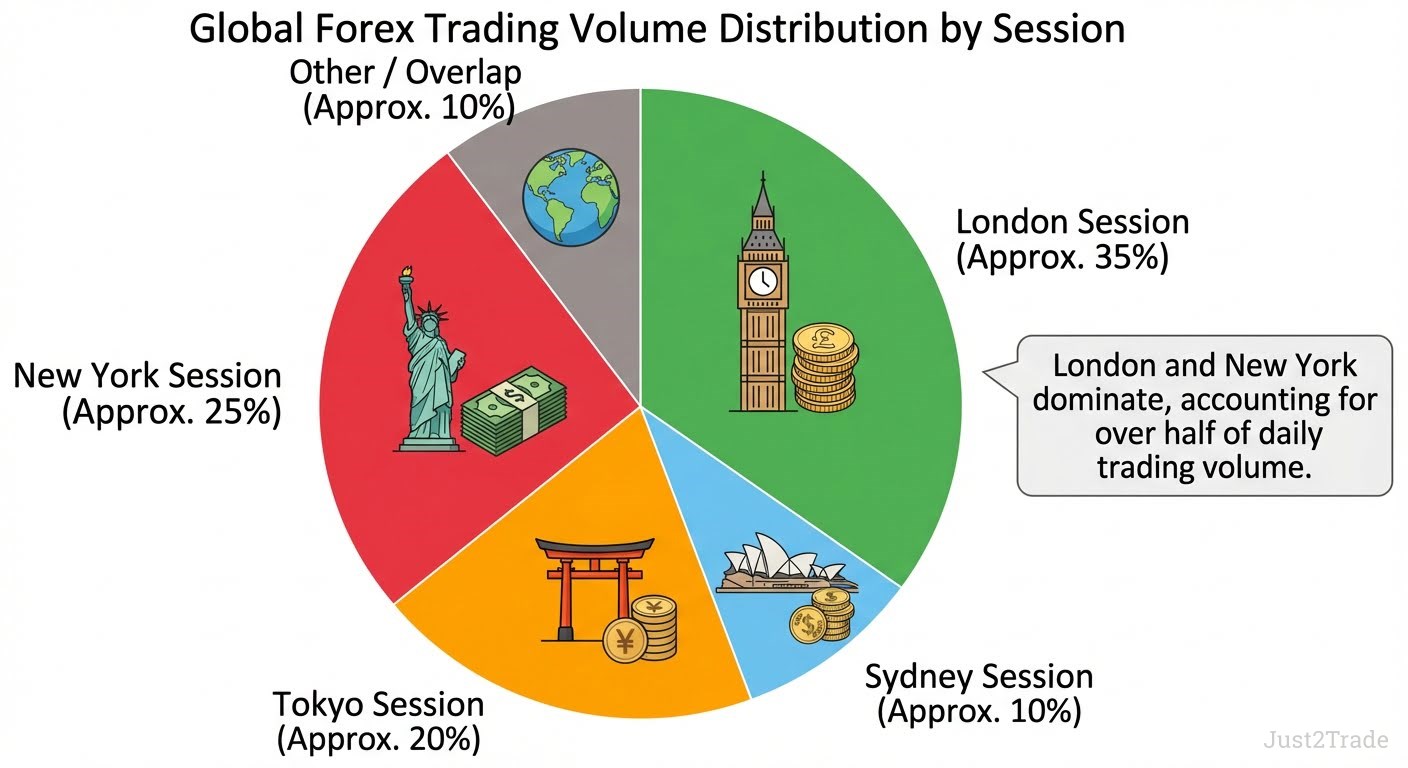
The London session dominates global forex market hours, capturing 30-35% of total daily trading volume. Operating 08:00-17:00 GMT (summer) or 07:00-16:00 GMT (winter), this European forex market window represents the highest volume session globally.
Why London Session Dominates:
| Factor |
Impact |
| Geographic position |
Bridges Asian and American hours |
| Currency influence |
EUR, GBP drive major pair activity |
| Bank participation |
ECB, Bank of England policy effects |
| Institutional flows |
Hedge funds, major banks most active |
| Peak activity window |
First 4 hours post-open |
The Bank of England and European Central Bank maintain significant influence during London session hours, with monetary policy decisions creating substantial price movements. GBP EUR trading intensifies dramatically when London opens.
European Currency Dynamics and Breakout Opportunities
EUR GBP trading defines the London session landscape. EUR/USD and GBP/USD exhibit the tightest spreads globally during these hours—often 0.1-0.3 pips compared to 1-2 pips during Asian sessions.
European currency pair characteristics:
- EUR/USD: 0.1-0.3 pip spreads, 60-100 pip daily ranges, ECB policy-driven
- GBP/USD: 0.2-0.5 pip spreads, 80-120 pip ranges, high volatility
- EUR/GBP: 0.3-0.6 pip spreads, 40-70 pip ranges, Brexit sensitivity
- USD/CHF: 0.5-1.0 pip spreads, safe-haven flows, SNB influence
London breakout strategy implementation targets the opening hour (08:00-09:00 GMT) when European institutional traders enter positions. Volume surges often break technical levels that held firm during Asian hours, creating 50-100 pip moves within minutes.
New York Trading Session: Americas Financial Hub
The New York session operates 13:00-22:00 GMT (winter) or 12:00-21:00 GMT (summer), representing 18-22% of global daily volume. USD dominance reaches its peak during Americas trading hours, as the world's reserve currency takes center stage.
New York Session Fundamentals:
- Session timing: 13:00-22:00 GMT (winter), 12:00-21:00 GMT (summer)
- Trading volume: Second-highest globally (20% daily total)
- Currency dominance: USD appears in 88% of all forex transactions
- Volatility drivers: Federal Reserve policy, US economic data
- Overlap benefit: 4-hour window with London (peak liquidity period)
The Federal Reserve's monetary policy decisions, non-farm payroll reports, and CPI releases all occur during US forex market hours, creating market-moving volatility that reshapes currency valuations instantly.
USD Pairs and North American Economic Impact
USD currency pairs demonstrate extreme sensitivity to US economic data during New York session hours. Major releases routinely generate 100+ pip moves in seconds.
High-impact economic events during New York hours:
| Event |
Typical Impact |
Affected Pairs |
Release Time (EST) |
| Non-Farm Payrolls |
100-200 pips |
All USD pairs |
08:30 First Friday |
| FOMC Rate Decision |
150-300 pips |
EUR/USD, GBP/USD, USD/JPY |
14:00 (8x yearly) |
| CPI (Inflation) |
80-150 pips |
USD majors |
08:30 Monthly |
| GDP Report |
60-120 pips |
USD/CAD, EUR/USD |
08:30 Quarterly |
The dollar dominance extends beyond direct USD pairs—EUR/GBP, AUD/NZD, and other crosses experience significant movement as traders adjust portfolios based on shifting USD strength or weakness.
Peak Trading Hours: Session Overlap Analysis
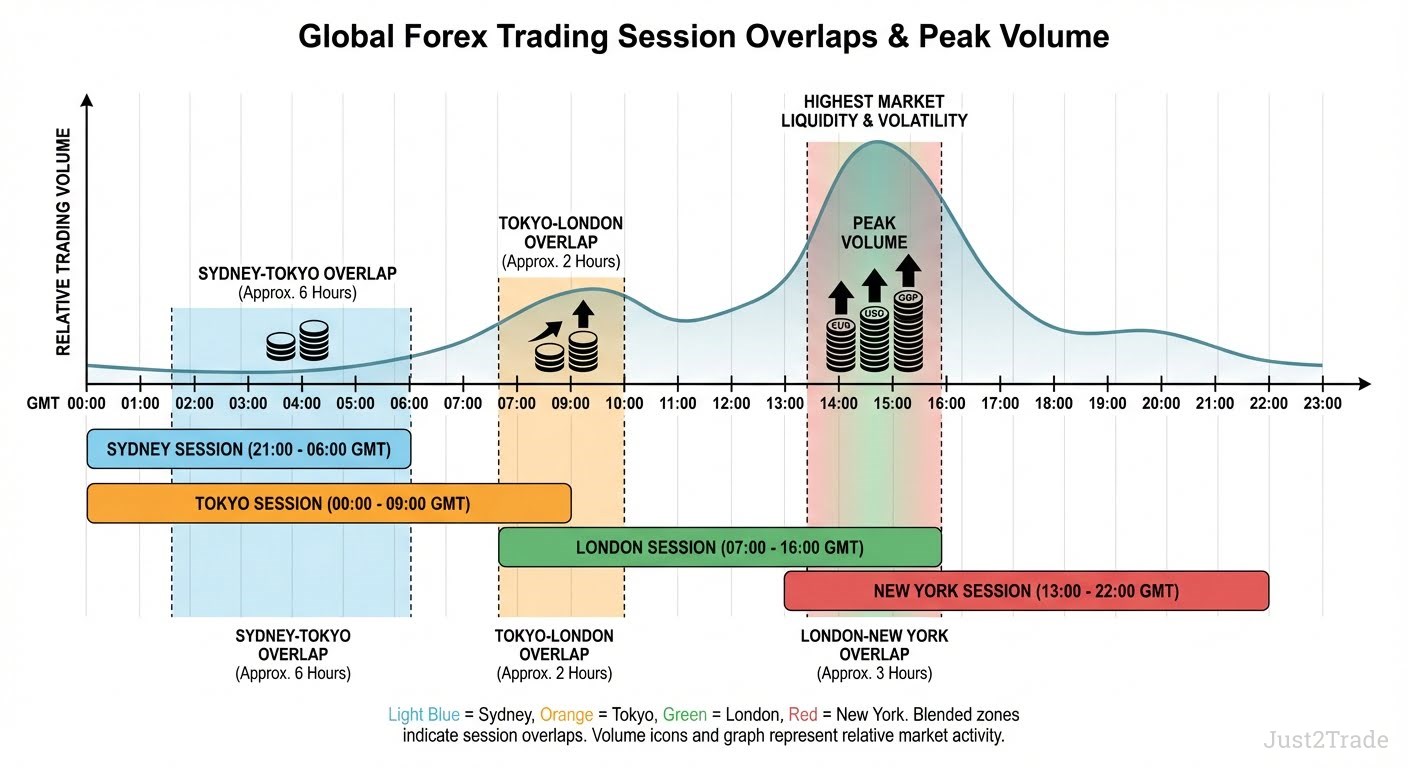
Forex session overlap periods deliver the most powerful peak trading hours for active traders. The London New York overlap from 13:00-17:00 GMT captures 60-70% of daily trading volume in just four hours—the single most important window in each 24-hour cycle.
Why Session Overlaps Matter:
- Volume concentration: 60-70% of daily trades during 4-hour London-NY window
- Spread compression: 50-80% tighter than single-session periods
- Volatility increase: Competing flows from different regions create trends
- Execution quality: Deep liquidity absorbs large orders efficiently
Best forex trading times occur when two major sessions operate simultaneously
The forex market structure creates three critical relationships:
| Overlap Period |
GMT Hours |
Daily Volume % |
Best For |
| Sydney-Tokyo |
00:00-07:00 |
8-12% |
Asian currency positioning |
| Tokyo-London |
08:00-09:00 |
12-15% |
Pre-European breakout setups |
| London-New York |
13:00-17:00 |
60-70% |
All active trading strategies |
Volume Distribution and Liquidity Advantages
Trading volume peaks during the London-New York overlap represent $3-4 trillion in daily turnover—approximately 40-50% of the entire $7.5+ trillion global daily forex liquidity compressed into four hours.
Practical overlap benefits for traders:
- Tight spreads: EUR/USD spreads of 0.1-0.3 pips vs 1-2 pips during Asian hours
- Reduced slippage: Deep liquidity pool absorbs orders at desired prices
- Transaction cost savings: $50-100 saved per 10 standard lots traded
- Better news execution: Liquidity cushions impact of volatile announcements
- Trending behavior: Sustained directional moves more common than choppy ranges
The relationship between high volume and reduced trading costs becomes particularly valuable for high-frequency traders operating on thin margins. Overlap benefits can determine profitability versus break-even performance.
How to Use a Forex Market Hours Clock
A forex market hours clock provides real-time session tracking, and every professional trader should integrate a forex market hours clock into their trading platform. These specialized trading session clock tools display active markets, calculate GMT conversion automatically, and highlight overlap periods visually.
Essential Forex Clock Features:
- Real-time display: Shows currently active sessions with color coding
- GMT conversion: Automatic timezone calculations eliminate confusion
- Session status indicators: Visual markers for open/closed/overlap periods
- Multiple timezone support: Coordinate globally regardless of location
- Volume indicators: Display typical liquidity patterns by session
- Economic calendar integration: Upcoming data releases with session timing
Modern forex market hours clock implementations integrate directly with trading platforms like MetaTrader 4/5, cTrader, and TradingView, offering customizable alerts when specific sessions open or close.
Digital Tools and Platform Integration
Forex clock tools have evolved into sophisticated applications offering dynamic trading platform integration. Leading platforms now incorporate session indicators directly onto price charts.
Advanced clock tool capabilities:
| Feature |
Benefit |
Platform Examples |
| Chart overlays |
Color-coded time periods by session |
MT4/MT5, TradingView |
| Volume profiles |
Historical liquidity patterns display |
cTrader, NinjaTrader |
| Automated triggers |
Positions open/close at session transitions |
MT4/MT5 EA capability |
| Economic calendars |
Release timing with session context |
Forex Factory, DailyFX |
Trading platform clocks enable automated session-based strategies—opening positions when London begins, tightening stops as New York closes, or activating algorithms during high-volume overlaps.
Weekend Trading and Market Gaps
Weekend forex trading remains extremely limited as all major financial centers close from Friday 22:00 GMT through Sunday 22:00 GMT. Traditional currency pair liquidity essentially disappears, creating unsuitable conditions for most strategies.
Weekend Market Characteristics:
- Market status: Closed Friday 22:00 GMT to Sunday 22:00 GMT
- Limited liquidity: If available, spreads widen 3-10x normal levels
- Gap risk: Price discontinuities between Friday close and Sunday open
- News sensitivity: Geopolitical events create potential for large gaps
The Monday forex open in Sydney frequently creates price gaps when significant weekend events occur. These market gaps represent discontinuous price action where no trading occurred between Friday's close and Sunday's reopening.
Gap Trading Strategy and Risk Management
Gap trading strategy specifically targets weekend gaps, profiting from either gap continuation or gap filling. Historical analysis shows approximately 70% of weekend gaps partially fill within the first few trading days.
Gap Trading Framework:
| Gap Size |
Typical Behavior |
Strategy Approach |
Risk Level |
| <20 pips |
80% fill within hours |
Fade the gap, target Friday close |
Low-Medium |
| 20-50 pips |
60-70% partial fill within 1-2 days |
Scale entries, take partial profits |
Medium |
| >50 pips |
40-50% continuation, strong news-driven |
Avoid or trade with trend |
High |
Risk management for gap trading:
- Position size: Limit to 0.5-1% of capital (vs normal 1-2%)
- Profit targets: Aim for 50-80% gap closure or full fill
- Stop losses: Place beyond next technical level
- Time management: Close positions within 24-48 hours typically
Daylight Saving Time Impact on Trading Sessions
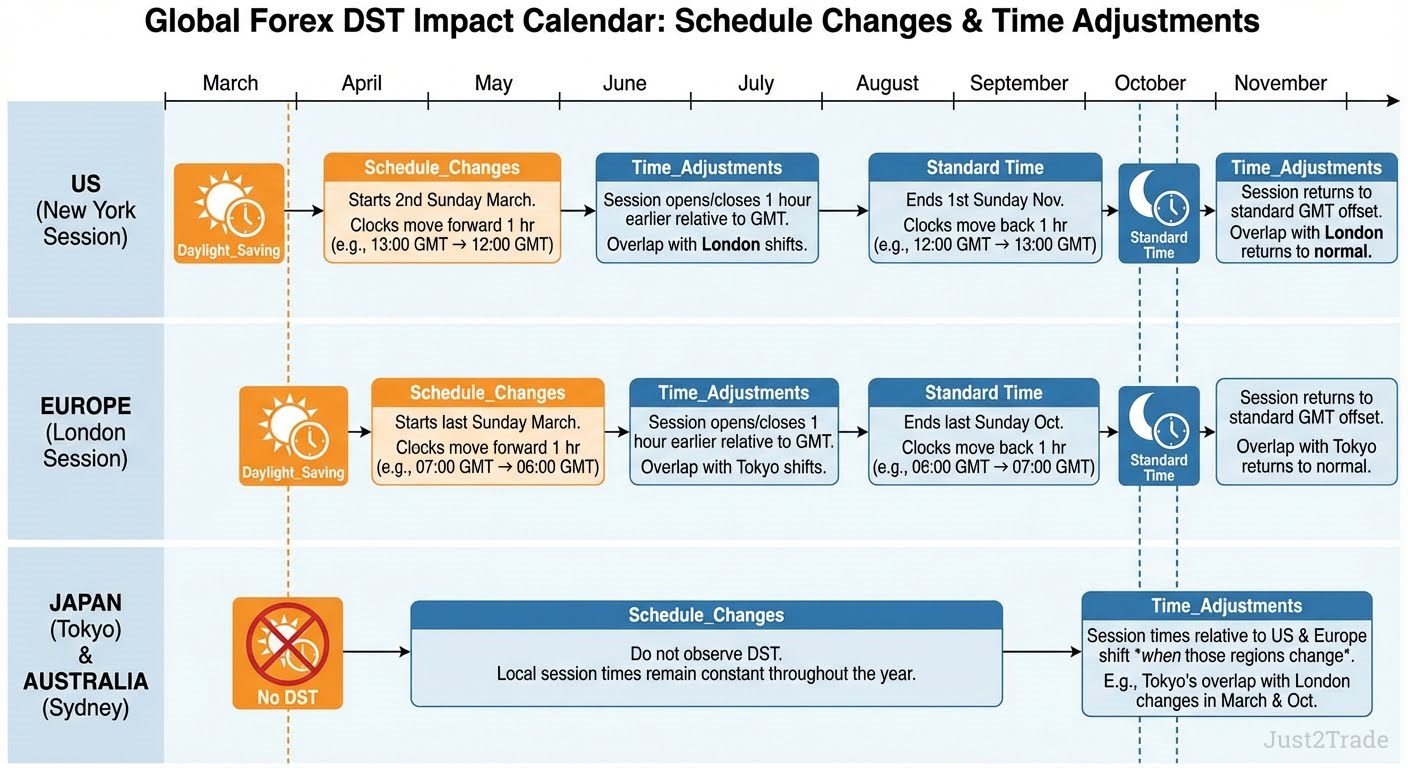
Daylight saving forex complications arise because regions transition at different times—the United States changes in early March and November, while Europe shifts in late March and October. These seasonal time changes create temporary periods where overlap duration shifts.
DST Impact by Session:
| Session |
Summer Hours (GMT) |
Winter Hours (GMT) |
DST Observation |
| Sydney |
22:00-07:00 |
21:00-06:00 |
Southern Hemisphere |
| Tokyo |
00:00-09:00 |
00:00-09:00 |
No DST (consistent) |
| London |
08:00-17:00 |
07:00-16:00 |
Late March/October |
| New York |
12:00-21:00 |
13:00-22:00 |
Early March/November |
GMT adjustments require traders to maintain updated schedules or use reliable forex market hours clock tools that automatically account for regional DST trading hours variations. The London-New York overlap maintains four-hour duration but shifts position slightly during transition periods.
Optimal Currency Pairs by Trading Session
Best currency pairs by session vary dramatically based on active financial centers. Session-specific trading success requires matching currency selection to optimal liquidity windows.
Currency Pair Optimization by Session:
Sydney Session (22:00-07:00 GMT):
- AUD/USD - Tightest spreads, highest liquidity
- NZD/USD - Commodity correlation plays
- AUD/NZD - Regional cross-pair advantage
- AUD/JPY - Asia-Pacific volatility capture
Tokyo Session (00:00-09:00 GMT):
- USD/JPY - Dominant liquidity, Bank of Japan influence
- EUR/JPY - European positioning ahead of London
- AUD/JPY - Commodity-driven moves
- GBP/JPY - Pre-London volatility setups
London Session (08:00-17:00 GMT):
- EUR/USD - Maximum global liquidity
- GBP/USD - Highest volatility, tight spreads
- EUR/GBP - Pure European play
- USD/CHF - Safe-haven dynamics
New York Session (13:00-22:00 GMT):
- EUR/USD - Peak overlap liquidity
- USD/CAD - North American focus
- GBP/USD - Continued European influence
- USD/MXN - Regional emerging market
Currency pair timing optimization ensures execution quality, manageable spreads, and predictable price behavior aligned with regional market participant activity.
Advanced Session Trading Strategies
Session trading strategies leverage unique characteristics of each window to implement timing-optimized approaches. Success requires matching strategy type to appropriate forex session strategy conditions.
Strategy-Session Alignment:
| Trading Style |
Optimal Session |
Rationale |
Entry Timing |
| Breakout Trading |
London open (08:00-09:00 GMT) |
Volume surge breaks Asian ranges |
First hour post-open |
| Intraday Trading |
London-NY overlap (13:00-17:00 GMT) |
Sustained trends, high liquidity |
Throughout overlap window |
| Scalping |
London-NY overlap (13:00-17:00 GMT) |
Tight spreads, rapid movements |
Continuous during overlap |
| Range Trading |
Sydney-Tokyo (22:00-09:00 GMT) |
Lower volatility, defined levels |
At support/resistance |
| Carry Trading |
Sydney session entries |
Minimal volatility during position |
Low-activity periods |
| News Trading |
Varies by release |
Economic data timing |
Immediate on announcement |
Time-based trading discipline requires resisting temptation to force activity during inappropriate sessions. A European trader naturally advantages EUR/USD and GBP/USD during London hours, while Asian traders benefit from home market expertise in JPY, AUD, and NZD pairs during Tokyo hours.
Conclusion: Mastering Forex Market Timing
Forex market hours mastery provides crucial competitive advantage for currency traders seeking consistent profitability. Understanding how trading session optimization aligns strategy implementation with optimal liquidity windows enables efficient execution, reduced costs, and superior risk management.
Key Takeaways for Market Timing Success:
- The four-hour London-New York overlap (13:00-17:00 GMT) offers peak liquidity and tightest spreads
- Session-specific currency pair selection maximizes execution quality
- DST transitions require schedule updates to maintain optimal timing
- Each session brings distinct volatility patterns and participant profiles
- Weekend gaps create Monday trading opportunities with elevated risk
Implementing a session-based trading approach requires discipline to trade only during personally optimal hours. Success increasingly depends on matching trading approach to session characteristics rather than applying identical strategies across all periods. Begin concentrating activity during high-volume windows while adjusting strategies to session-specific conditions for improved market timing success.
FAQ
-
When does the forex market close for the week?
The forex market closes Friday at 22:00 GMT when the New York session ends. Markets remain closed until Sunday 22:00 GMT when Sydney reopens. Traders should close positions or adjust stop-losses before weekend to avoid gap risk at Monday's open. The Friday evening closure in New York (17:00 EST) marks the official end of the trading week.
-
What's the difference between GMT and EST forex hours?
GMT (Greenwich Mean Time) serves as the universal reference standard, while EST (Eastern Standard Time) is GMT-5 hours during winter and GMT-4 hours during summer daylight saving. London session in EST: 03:00-12:00 (winter), 04:00-13:00 (summer). New York session: 08:00-17:00 EST consistently.
-
Which session is best for scalping strategies?
The London-New York overlap (13:00-17:00 GMT) provides optimal scalping conditions with maximum liquidity, tightest spreads (0.1-0.3 pips on EUR/USD), and elevated volatility. This four-hour window enables scalpers to execute numerous trades with minimal transaction costs and rapid price movements creating multiple entry/exit points.
-
How do economic announcements affect session trading?
Economic announcements create instant volatility spikes—US non-farm payroll releases during New York hours routinely move EUR/USD 100+ pips within minutes. High-impact data (interest rate decisions, GDP, inflation) from Federal Reserve, ECB, or Bank of England should prompt traders to avoid positions or use wider stops during announcement windows.
-
Are forex market hours the same year-round?
No—daylight saving time creates seasonal variations where session times shift one hour during summer. London operates 08:00-17:00 GMT (summer) versus 07:00-16:00 GMT (winter). New York runs 12:00-21:00 GMT (summer) versus 13:00-22:00 GMT (winter). These shifts affect overlap duration and require schedule adjustments.
-
What happens during low liquidity sessions?
Low liquidity during Sydney and early Tokyo sessions causes spread widening (1-2 pips wider than London), increased slippage, and heightened susceptibility to price manipulation. Trading volume during Asian hours represents only 10-15% of daily totals, creating choppy, range-bound price action less suitable for momentum strategies.
-
Can I trade all currency pairs in every session?
While technically all pairs trade 24 hours, liquidity varies dramatically. EUR/USD exhibits tight spreads during London but wider spreads during Sydney hours when European traders are inactive. Currency availability remains constant, but execution quality, spread costs, and slippage differ substantially based on whether the currency's home market is currently active.
-
How do I account for holidays in different financial centers?
Market holidays in major financial centers create regional closures reducing liquidity significantly. Christmas, New Year's, and national holidays in UK, US, Japan, or Australia thin trading volume even if other centers remain open. Check economic calendars for holiday schedules across all markets and avoid trading during multi-region holidays when liquidity becomes unpredictable and spreads widen.