Prognoza cen kawy na rok 2026: Analiza ekspertów dotycząca przyszłości
)
Spis treści
Kluczowe informacje o cenach kawy w 2025-2026:
Aktualna sytuacja na światowym rynku kawy
Porównanie Odmian Arabica i Robusta
Kluczowe czynniki wpływające na wzrost cen kawy
Prognoza cen kawy na 2026 rok
Prognoza cen kawy na 2026
Jak zmiany rynkowe wpływają na różne kraje
Globalne trendy popytu i zachowania konsumentów
Wpływ rynków finansowych na ceny kawy
Perspektywy długoterminowe na lata 2027-2030
Prognoza cen kawy na 2027 rok
Prognoza cen kawy na 2028 rok
Prognoza cen kawy na 2029 rok
Prognoza cen kawy na 2030 rok
Wnioski: Jak radzić sobie z niepewną przyszłością kawy
FAQ: Pytania dotyczące prognoz cen kawy
Globalne ceny kawy osiągnęły najwyższe poziomy od dziesięcioleci, a prognozy na 2026 rok wskazują na kontynuację wzrostowej tendencji.
Kluczowe informacje o cenach kawy w 2025-2026:
- Arabica: cena grudniowa 2025 wynosi 7,83-8,42 USD/kg, wzrost +6-9% w skali roku.
- Robusta: cena grudniowa 2025 to 4,20 USD/kg, spadek -16,7% w skali roku.
- Spread cenowy: Spread cenowy: różnica między odmianami osiągnęła 4,23 USD/kg (grudzień 2025).
- Produkcja globalna 2024: Arabica 102,065 mln worków (57,5% rynku), Robusta 75,448 mln worków (42,5%).
- Zapasy rekordowo niskie: certyfikowane zapasy Arabiki spadły o 47% do 0,48 mln worków.
- Deficyt rynkowy: łączny deficyt 17,91 mln worków w latach 2021-2024.
- Eksport Robusty: wzrost +21,8% w listopadzie 2025 (4,11 mln worków).
- Cykl brazylijski: rok 2025/26 będzie "on-year" dla Arabiki - oczekiwany wzrost produkcji.
- Prognozy 2026: Arabica 7,94-8,82 USD/kg, Robusta 4,41-5,07 USD/kg.
- Zawartość kofeiny: Arabica 1,2-1,5%, Robusta 2,2-2,7%.
Aktualna sytuacja na światowym rynku kawy
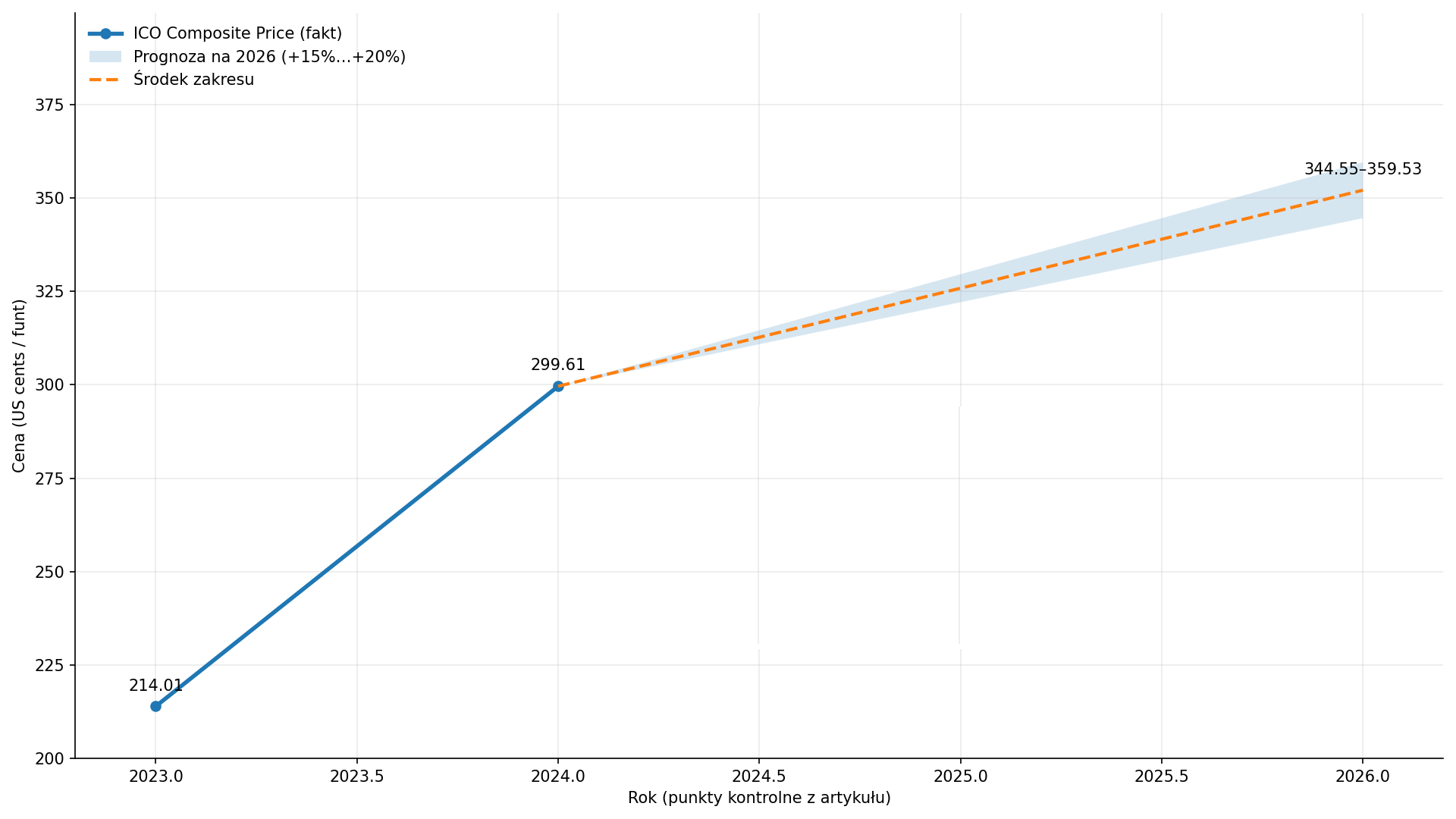
Ceny kawy: trend z ostatnich lat i prognoza na 2026
Historia produkcji i konsumpcji (2021-2024)
| Rok |
Produkcja Arabica (mln worków) |
Produkcja Robusta (mln worków) |
Konsumpcja globalna (mln worków) |
Balans rynku |
| 2021 |
91,737 |
73,356 |
170,500 |
-5,407 |
| 2022 |
93,876 |
71,910 |
176,855 |
-11,070 |
| 2023 |
97,674 |
71,033 |
172,578 |
-3,871 |
| 2024 |
102,065 |
75,448 |
175,071 |
+2,443 |
Historia cen kawy Robusta (2024-2025)
Rynek kawy Robusta w latach 2024-2025 charakteryzował się ekstremalną zmiennością cenową na giełdzie ICE Futures Europe. Ceny wahały się od 3,10 USD/kg w lutym 2024 do szczytu 5,69 USD/kg w styczniu 2025. Szczególnie dramatyczny był sierpień 2025 z wzrostem +44,55% po spadku do 3,33 USD/kg w lipcu. Styczeń 2026 pokazuje stabilizację na poziomie 4,03 USD/kg. Średnia cena w okresie wyniosła 4,42 USD/kg.
Uwaga metodologiczna: Dane przeliczono z notowań giełdowych (USD/tona) na USD/kg. Niewielkie różnice mogą wynikać z zaokrągleń.
| Data |
Cena (USD/kg) |
Otwarcie (USD/kg) |
Maksimum (USD/kg) |
Minimum (USD/kg) |
Wolumen |
Zmiana % |
| Luty 2024 |
3,10 |
3,17 |
3,24 |
2,98 |
235.18K |
-2,30% |
| Marzec 2024 |
3,40 |
3,10 |
3,49 |
3,09 |
167.43K |
+9,73% |
| Kwiecień 2024 |
4,02 |
3,41 |
4,34 |
3,41 |
275.34K |
+18,40% |
| Maj 2024 |
3,99 |
4,01 |
4,22 |
3,26 |
218.81K |
-0,85% |
| Czerwiec 2024 |
4,01 |
3,99 |
4,39 |
3,97 |
187.02K |
+0,60% |
| Lipiec 2024 |
4,12 |
4,02 |
4,68 |
3,95 |
155.84K |
+2,62% |
| Sierpień 2024 |
4,95 |
4,10 |
5,18 |
3,93 |
208.85K |
+20,21% |
| Wrzesień 2024 |
5,23 |
4,92 |
5,49 |
4,66 |
145.30K |
+5,60% |
| Październik 2024 |
4,37 |
5,23 |
5,24 |
4,30 |
192.35K |
-16,38% |
| Listopad 2024 |
5,31 |
4,32 |
5,61 |
4,18 |
83.80K |
+21,54% |
| Grudzień 2024 |
4,81 |
5,24 |
5,44 |
4,45 |
55.76K |
-9,51% |
| Styczeń 2025 |
5,69 |
4,90 |
5,84 |
4,84 |
153.20K |
+18,50% |
| Luty 2025 |
5,33 |
5,69 |
5,85 |
5,27 |
176.47K |
-6,39% |
| Marzec 2025 |
5,26 |
5,30 |
5,69 |
5,24 |
82.03K |
-1,26% |
| Kwiecień 2025 |
5,32 |
5,28 |
5,47 |
4,56 |
79.07K |
+1,01% |
| Maj 2025 |
4,46 |
5,34 |
5,38 |
4,39 |
141.53K |
-16,05% |
| Czerwiec 2025 |
3,62 |
4,42 |
4,60 |
3,46 |
213.69K |
-18,89% |
| Lipiec 2025 |
3,33 |
3,61 |
3,70 |
3,17 |
172.52K |
-7,98% |
| Sierpień 2025 |
4,82 |
3,33 |
4,99 |
3,23 |
226.17K |
+44,55% |
| Wrzesień 2025 |
4,14 |
4,67 |
4,79 |
3,99 |
81.41K |
-13,96% |
| Październik 2025 |
4,46 |
4,16 |
4,76 |
4,10 |
62.36K |
+7,72% |
| Listopad 2025 |
4,34 |
4,48 |
4,69 |
4,05 |
94.58K |
-2,87% |
| Grudzień 2025 |
3,87 |
4,30 |
4,31 |
3,61 |
71.58K |
-10,68% |
Źródło: Investing.com
Porównanie Odmian Arabica i Robusta
Wykres USDA ilustruje rekordową globalną produkcję kawy w latach 2020-2026, z Brazylią jako zdecydowanym liderem (czerwony segment stanowi około jednej trzeciej całości). Wietnam, Kolumbia, Indonezja i Etiopia uzupełniają czołówkę producentów, a łącznie pięć krajów dominuje na światowym rynku kawy, utrzymując stabilne udziały mimo stopniowego wzrostu całkowitej produkcji.
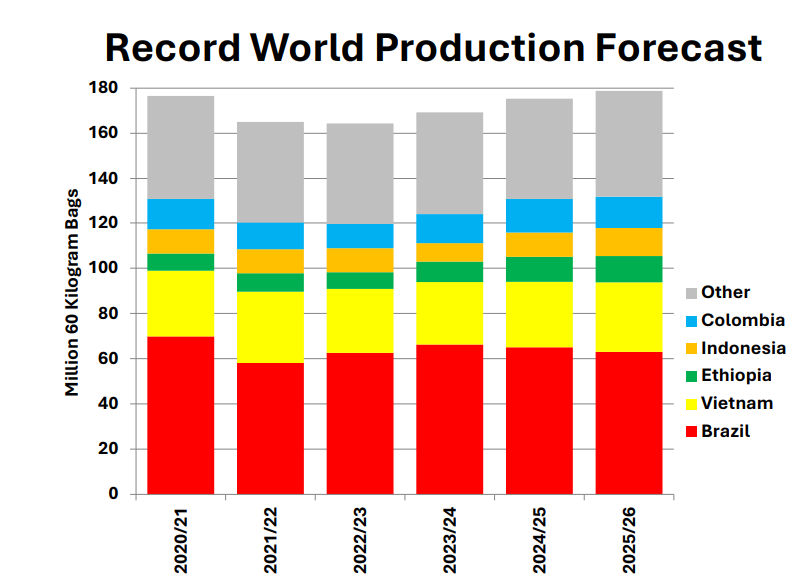
Źródło: USDA
Globalny rynek kawy w 2025 roku pokazał wyraźną dywergencję między odmianami – ceny Arabiki wzrosły o 6-9%, podczas gdy Robusta potaniała o 16,7%. Różnica cenowa między odmianami osiągnęła rekordowe poziomy, a certyfikowane zapasy obu gatunków spadły do wieloletnich minimów.
Charakterystyka i różnice między odmianami (2025-2026)
| Parametr |
Arabica |
Robusta |
| Cena średnia (grudzień 2025) |
7,83–8,42 USD/kg |
4,20 USD/kg |
| Produkcja globalna (2024) |
102,065 mln worków |
75,448 mln worków |
| Udział w rynku globalnym |
57,5% |
42,5% |
| Zmiana ceny roczna (2025 vs 2024) |
+6,2% do +9,4% |
-16,7% |
| Eksport (listopad 2025) |
6,363 mln worków (-5,2% r/r) |
4,110 mln worków (+21,8% r/r) |
| Zapasy certyfikowane (grudzień 2025) |
0,48 mln worków (USA) |
1,01 mln worków (Londyn) |
| Główni producenci |
Brazylia, Kolumbia, Peru |
Wietnam, Indonezja, Uganda |
| Zawartość kofeiny |
1,2–1,5% |
2,2–2,7% |
| Wysokość uprawy |
800–2200 m n.p.m. |
0–800 m n.p.m. |
| Prognoza ceny 2026 |
7,94–8,82 USD/kg |
4,41–5,07 USD/kg |
Źródło: ICO Coffee Market Report, USDA
Kluczowe czynniki wpływające na wzrost cen kawy
Cena kawy: wzrost w 2024 roku
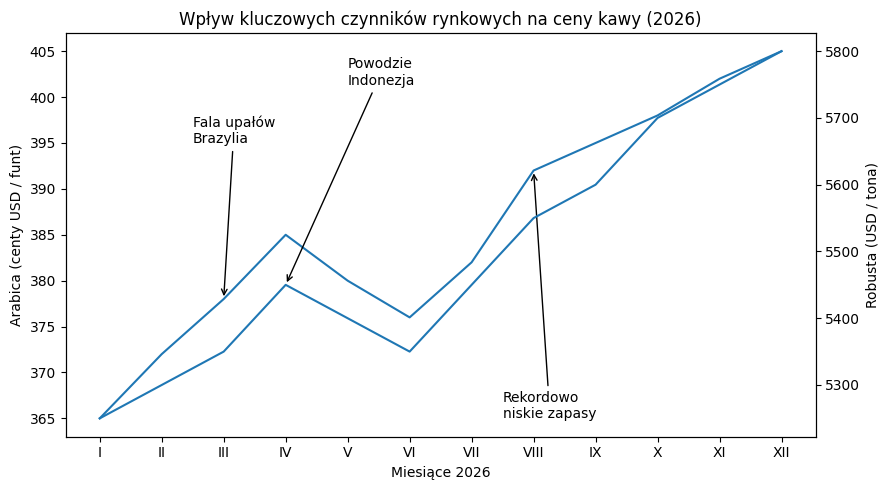
Rynek kawy na przełomie 2025 i 2026 roku kształtują przede wszystkim rekordowo niskie zapasy oraz ekstremalne zjawiska pogodowe w kluczowych regionach produkcyjnych. Według raportu ICO, certyfikowane zapasy Arabiki w magazynach ICE w USA spadły o 47% – z 0,91 mln worków w styczniu 2025 do 0,48 mln w grudniu 2025, najniższy poziom od lat. Równolegle zapasy konsumenckie w Europie skurczyły się z 15,04 mln worków na początku roku kawowego 2022/23 do zaledwie 7,86 mln worków na 31 października 2025.
Top 5 czynników wpływających na ceny w 2026 roku:
- Rekordowo niskie zapasy globalne – piąty rok z rzędu deficytu na rynku, mimo rekordowej produkcji 178,8 mln worków prognozy USDA wskazują na dalszy spadek zapasów końcowych do 20,1 mln worków
- Powodzie w Indonezji (grudzień 2025) – według Stowarzyszenia Indonezyjskich Eksporterów Kawy ekstremalne ulewy dotknęły 1/3 plantacji Arabiki w północnej Sumatrze, eksport może spaść o 15% w sezonie 2025/26
- Fala upałów w Brazylii (grudzień 2025 - styczeń 2026) – prognozy meteorologiczne wskazują na ekstremalną falę upałów w kluczowych regionach uprawy Arabiki (Minas Gerais), co zagraża plonom w 2026/27
- Umocnienie brazylijskiego reala – silniejsza waluta krajowa zniechęca brazylijskich producentów do eksportu, dodatkowo ograniczając globalną podaż na międzynarodowych rynkach
- Eksplozja popytu w Chinach – według Perfect Daily Grind w ciągu 12 miesięcy w Chinach otwarto ponad 20 000 nowych kawiarni (wzrost o 18,4% do 180 268 punktów w Azji Wschodniej), Chiny stały się jedynym rynkiem na świecie, który dodał ponad 20 000 nowych lokali w jednym roku
Dodatkowe czynniki ryzyka: napięcia geopolityczne USA-Wenezuela po operacji militarnej w styczniu 2026, problemy logistyczne w brazylijskich portach (eksporterzy stracili 8,7 mln reali tylko w październiku 2025 z powodu opóźnień), rosnące koszty produkcji nawozów i energii.
Jak klimat wpływa na kluczowych producentów
- Brazylia: Ekstrema fala upałów – według Somar Meteorologia region Minas Gerais otrzymał jedynie 38,3 mm opadów zamiast 150 mm, zagrożenie dla plonu 2026/27
- Indonezja: Niszczycielskie powodzie dotknęły 1/3 plantacji Arabiki w północnej Sumatrze, prognoza spadku eksportu o 15% według Stowarzyszenia Indonezyjskich Eksporterów Kawy
- Wietnam: Wzrost eksportu +39% w listopadzie 2025 mimo wcześniejszych susz, jednak niestabilność produkcji w nadchodzących sezonach
- Uganda: Produkcja wzrosła do 6,88 mln worków w MY 2025/26 (+2,6% r/r) dzięki korzystnej pogodzie i programom wsparcia. Kraj doświadczył wzrostu temperatury o 1,3°C w ciągu ostatniego stulecia, ale skutecznie adaptuje się przez odmiany odporne na suszę
- Honduras: Produkcja wzrosła do 5,8 mln worków (+5% r/r) w MY 2025/26 dzięki niskiej zachorowalności na rdzę (2,9%) i stabilnej pogodzie. Eksport osiągnął 5,5 mln worków, a ceny wzrosły o 81% do $345,82 za worek – największy wzrost w regionie Ameryki Środkowej
- Peru: Produkcja 4,2 mln worków w 2025/26, eksport wzrósł o 25,3% w czerwcu 2025. Kraj pozostaje liderem w certyfikowanej Fair Trade i organicznej Arabice, mimo problemów z dostępnością siły roboczej podczas zbiorów
- Mekyk: Produkcja 3,54 mln worków w 2025/26 – niewielki spadek. Główne regiony uprawy (Chiapas, Veracruz) rozwijają shade-grown i organiczną produkcję jako odpowiedź na zmiany klimatyczne
- Indie: Produkcja spadła do 1,35 mln worków w 2025/26 (z 1,4 mln w 2024/25). Regiony Karnataka, Kerala i Tamil Nadu doświadczają zmiennych wzorców opadów wpływających na charakterystyczny monsoonowy proces przetwarzania
Konsekwencje: Piąty rok z rzędu spadających zapasów globalnych – USDA prognozuje spadek do 20,1 mln worków, co utrzymuje ceny na podwyższonym poziomie mimo rekordowej produkcji 178,8 mln worków w 2025/26
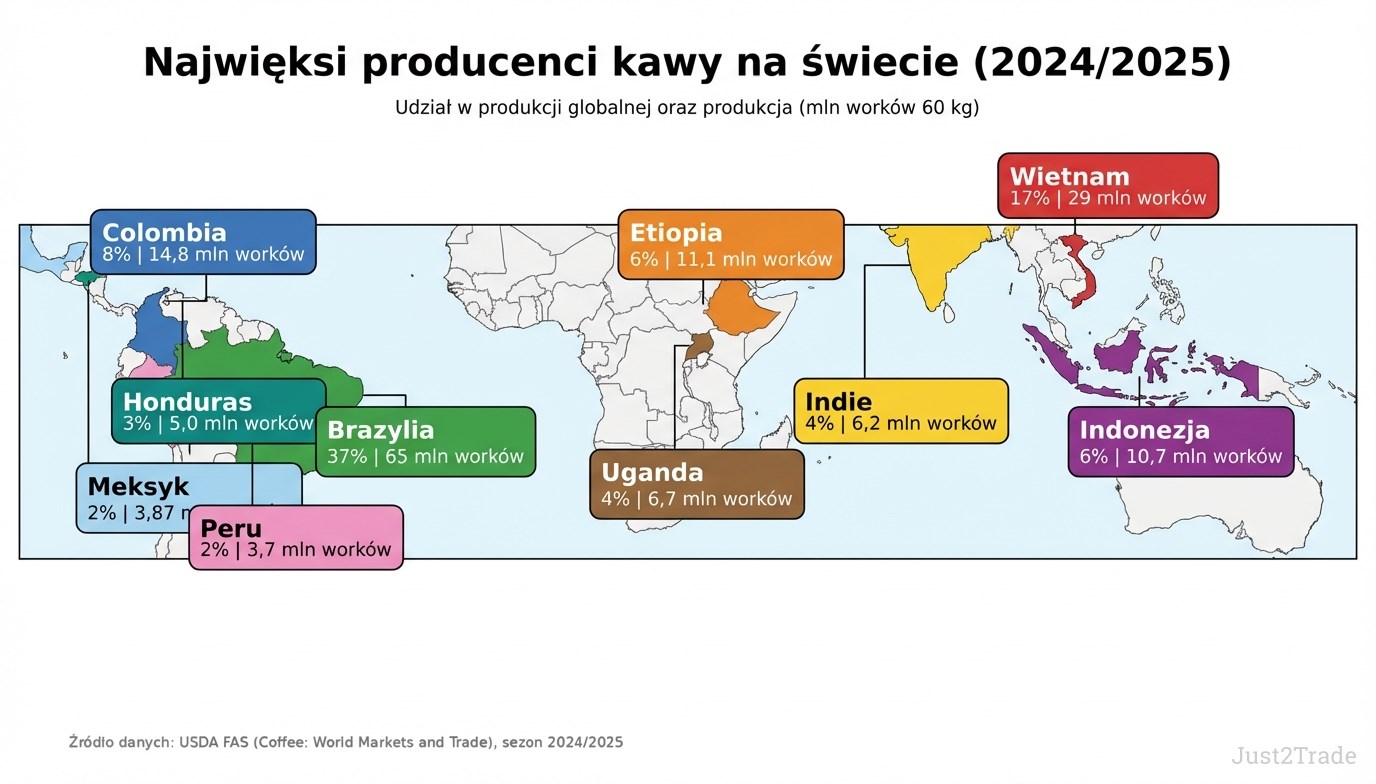
Producenci kawy najbardziej dotknięci zmianą klimatu
Zakłócenia w łańcuchu dostaw i koszty produkcji
Rok 2025 przyniósł bezprecedensowe zakłócenia w globalnym łańcuchu dostaw kawy, zdominowane przez cła handlowe USA wprowadzone na wiosnę oraz ekstremalne warunki pogodowe. Administracja Trumpa nałożyła bazowe cło 10% na cały import kawy, z dodatkowymi karami dla kluczowych producentów: Brazylia 50%, Indonezja 32% (później obniżone do 19%), Wietnam 46% (obniżone do 20% w połowie 2025), Indie 25%. Cła te, płacone przez amerykańskich importerów, bezpośrednio podniosły koszty o 10-50% w zależności od pochodzenia.
Główne zakłócenia w łańcuchu dostaw (2025-2026):
- Cła handlowe USA
– Brazylia (50% na 30% amerykańskich dostaw), Indonezja (19-32%), Wietnam (20-46%). Cały sektor płaci minimum 10% bazowego cła, eliminując konkurencyjność małych importerów
- Powodzie w Indonezji – ekstremalne ulewy pod koniec 2025 roku dotknęły 1/3 plantacji, prognoza spadku eksportu o 15%. Przyspieszenie dostaw do UE przed wejściem w życie EUDR
- Brazylijskie opóźnienia portowe – eksporterzy stracili 8,7 mln reali (1,6 mln USD) w 2025 z powodu demurrage i opóźnień celnych
- EUDR (2025) – Unia Europejska odroczyła regulację o kolejny rok po apelach branży, ale eksporterzy intensyfikują przygotowania do wymogów śledzowalności
- Rosnące koszty produkcji – nawozy, energia, transport oraz wymogi compliance zwiększają koszty o 5-7% rocznie według ICO
Wpływ na ceny: Według ICO z końca 2025, cena kawy spadła do 304 US cents/lb po częściowym cofnięciu ceł i poprawie prognoz dostaw, jednak ceny pozostają o 30,3% wyższe niż rok wcześniej.
Prognoza cen kawy na 2026 rok
Eksperci przewidują dalszy wzrost cen kawy w 2026 roku. Reuters cytuje prognozy analityków rynku finansowego wskazujące na arabicę osiągającą 3,80-4,20 USD za funt. Brazylia przewiduje produkcję 66,4 mln worków, a dla sezonu 2025/26 konsultanci Safras & Mercado szacują 62,45 mln worków (-5% r/r).
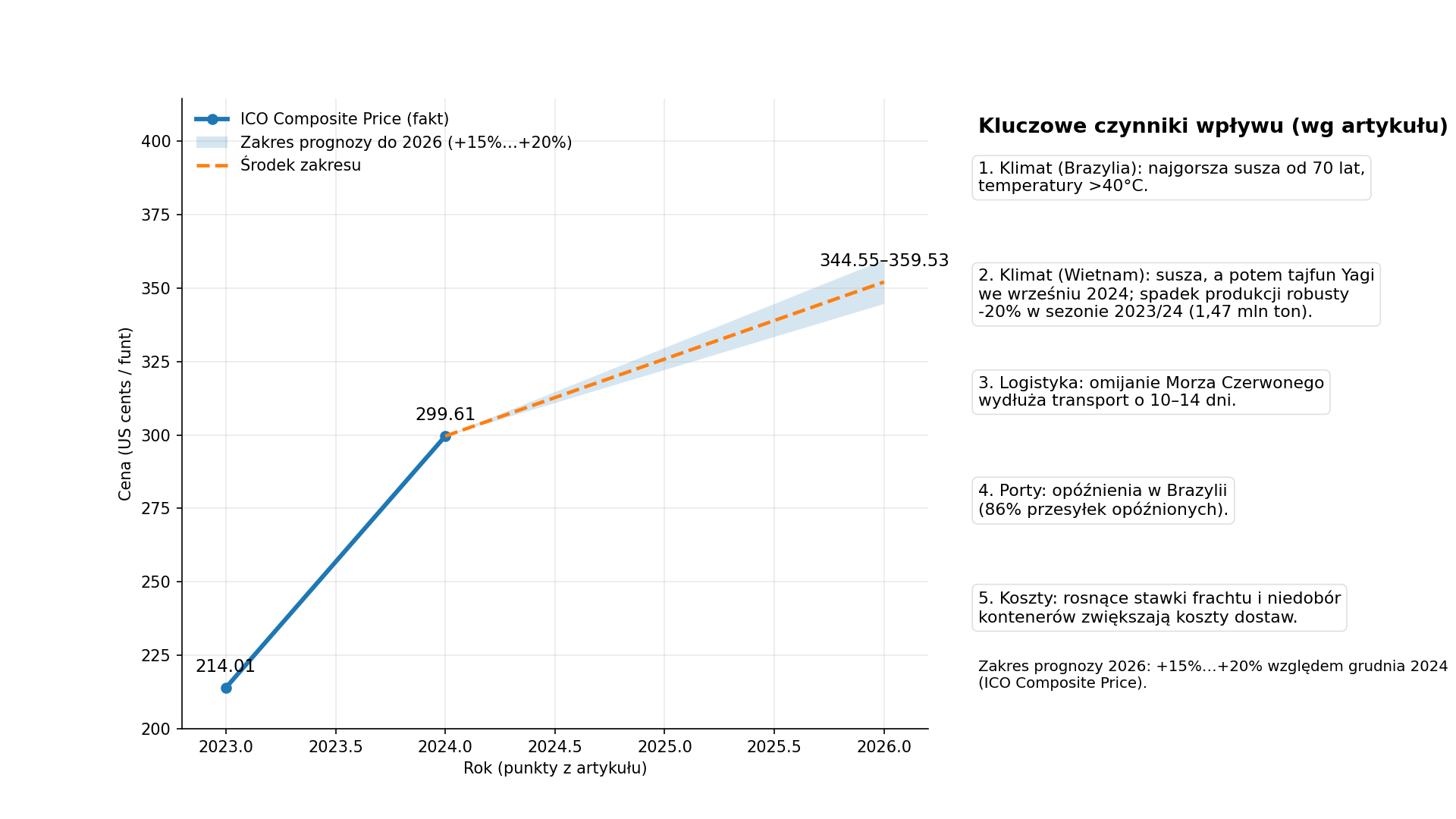
Prognoza cen kawy na 2026 rok
Arabica może osiągnąć 8,38-9,26 USD za kilogram w 2026 roku, podczas gdy robusta może osiągnąć 4,43-4,67 USD za kilogram. Rynek finansowy, szczególnie fundusze inwestycyjne, zwiększa ekspozycję na kawę jako zabezpieczenie przed inflacją.
| Kwartał |
Prognoza Arabica (USD/kg) |
Prognoza Robusta (USD/kg) |
Kluczowy czynnik |
| Q1 2026 |
7,83–8,27 |
4,19–4,36 |
Ocena szkód po sezonie 2024/25 |
| Q2 2026 |
8,05–8,60 |
4,32–4,48 |
Sezon zbiorów w Brazylii |
| Q3 2026 |
8,27–8,93 |
4,39–4,61 |
Popyt letni, stan plantacji |
| Q4 2026 |
8,38–9,26 |
4,43–4,67 |
Zapasy przed nowym sezonem |
Prognoza cen kawy na 2026
Według prognoz technicznych, ceny kawy wzrosną z 7,82-7,92 USD/kg na początku roku do 8,59-8,66 USD/kg pod koniec 2026 roku, co oznacza wzrost o około 10,5%. Najniższe ceny spodziewane są w lutym (7,82 USD/kg), podczas gdy szczyt osiągną w grudniu, przekraczając próg 8,59 USD/kg. Średnia roczna cena ustabilizuje się na poziomie około 8,15-8,25 USD/kg.
Uwaga metodologiczna: Poniższe dane przeliczono z oryginalnych notowań giełdowych (centy za funt) na dolary amerykańskie za kilogram dla lepszej czytelności i porównywalności z pozostałymi danymi w artykule.
| Miesiąc |
Cena otwarcia (USD/kg) |
Cena zamknięcia (USD/kg) |
Cena minimalna (USD/kg) |
Cena maksymalna (USD/kg) |
| Luty 2026 |
7,82 |
7,92 |
7,82 |
7,93 |
| Marzec 2026 |
7,92 |
7,96 |
7,92 |
7,96 |
| Kwiecień 2026 |
7,96 |
8,10 |
7,96 |
8,11 |
| Maj 2026 |
8,09 |
8,05 |
8,04 |
8,09 |
| Czerwiec 2026 |
8,05 |
8,04 |
8,03 |
8,07 |
| Lipiec 2026 |
8,04 |
8,14 |
8,03 |
8,15 |
| Sierpień 2026 |
8,15 |
8,40 |
8,15 |
8,40 |
| Wrzesień 2026 |
8,42 |
8,38 |
8,37 |
8,45 |
| Październik 2026 |
8,38 |
8,43 |
8,38 |
8,46 |
| Listopad 2026 |
8,43 |
8,58 |
8,43 |
8,58 |
| Grudzień 2026 |
8,59 |
8,66 |
8,58 |
8,66 |
Jak zmiany rynkowe wpływają na różne kraje
Wysokie ceny kawy tworzą odmienne efekty w różnych krajach producentach. Pod koniec 2025 roku kluczowe wydarzenia zmieniły globalny rynek: powodzie w Wietnamie, częściowe zniesienie taryf amerykańskich na kawę brazylijską oraz rekordowe zbiory w Kolumbii.
Wpływ według regionów:
- Brazylia: W 2025 eksport spadł o 20% w wolumenie, ale przychody wzrosły o 30% dzięki wysokim cenom. Taryfy 50% ograniczyły eksport do USA, częściowo zniesione w listopadzie. Problemy logistyczne w portach oraz wyczerpujące się zapasy ograniczają dostawy.
- Wietnam: Katastrofalne powodzie w listopadzie zakłóciły zbiory robusty w środku sezonu. Eksport spadł o 47%, ceny globalnie wzrosły z powodu niedoborów podaży.
- Kolumbia: Rekordowa produkcja 13,9-14,87 mln worków (+23%), najwyższa od 30 lat. Taryfy amerykańskie 10% częściowo zniesione w listopadzie. Pojawiły się podejrzenia o mieszanie kawy brazylijskiej.
- Etiopia: Wzrost eksportu dzięki reformom rynkowym. Prognoza rekordowej produkcji 11,6 mln worków w sezonie 2025/26.
- Indonezja: Odbicie produkcji po trudnym sezonie. Powodzie wpłynęły na plantacje arabiki. Reorientacja eksportu z USA na Azję i Bliski Wschód.
Globalne trendy popytu i zachowania konsumentów
Globalny popyt na kawę pozostaje silny mimo rekordowych cen. Region Azji, szczególnie Chiny, napędza wzrost globalnej konsumpcji – Chiny zwiększają import z Brazylii o 65% r/r, wspierane umową o wartości 500 milionów USD z Luckin Coffee, największą siecią kawiarni w Chinach. Kolumbia odnotowała wzrost eksportu do Chin o 246% rok do roku. Indie, tradycyjnie producent herbaty, zwiększają konsumpcję kawy wśród młodszych konsumentów.
Konsumpcja krajowa w głównych krajach producentach pozostaje stabilna – Brazylia: 22,28 mln worków, Kolumbia: 2,3 mln worków (+4% r/r). Młodsi konsumenci w Kolumbii napędzają wzrost zainteresowania kawą specialty. Konsumpcja per capita w Kolumbii wynosi 2,8 kg, znacznie poniżej innych krajów producentów, co wskazuje na potencjał wzrostu popytu wewnętrznego. US National Coffee Association raportuje, że mimo wysokich cen, 67% Amerykanów pije kawę codziennie, potwierdzając odporność popytu na wzrosty cen.
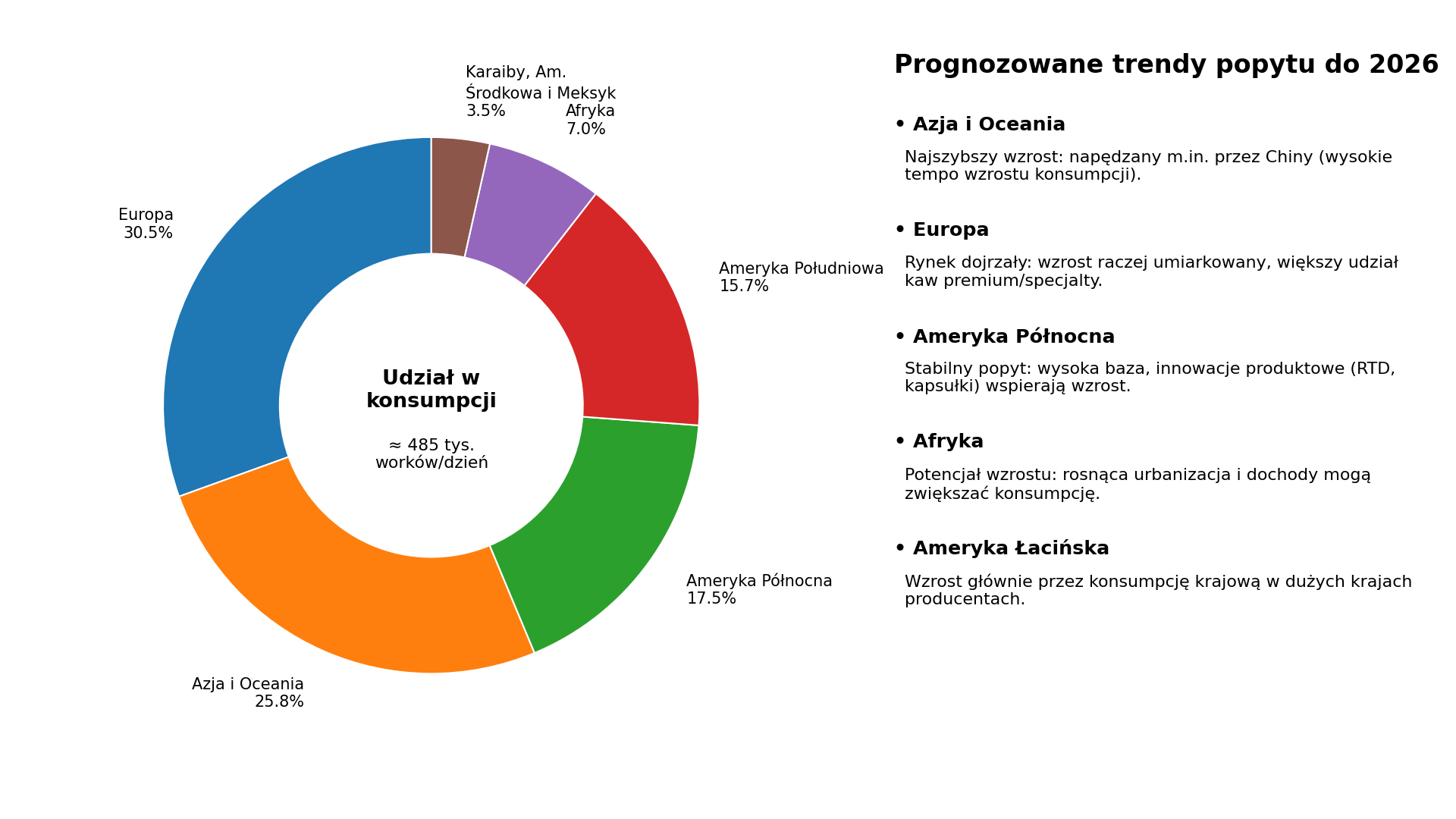
Konsumpcja kawy na świecie – udziały regionów i perspektywy wzrostu
Wpływ rynków finansowych na ceny kawy
Rynki finansowe amplifikują wahania cen kawy poprzez spekulacje kontraktami terminowymi. Inwestorzy finansowi, reagując na prognozy niedoborów podaży, kupują kontrakty na giełdach ICE w Nowym Jorku i Londynie, co napędza ceny niezależnie od rzeczywistego popytu na kawę.
Arbitraż między rynkami arabiki i robusty pogłębia rozpiętości cenowe – gdy inwestorzy przewidują niedobory jednego gatunku, kapitał przepływa między kontraktami, zwiększając różnice cen. Wysoka zmienność (powyżej 14% w 2024-2025) przyciąga fundusze hedgingowe, które zarabiają na wahaniach, dodatkowo destabilizując rynek.
Przykłady z 2025 roku:
- Listopad 2025 – powodzie w Wietnamie spowodowały gwałtowny wzrost cen robusty na spekulacjach o niedoborach, mimo że rzeczywisty wpływ na zbiory był ograniczony lokalnie
- Grudzień 2025 – ICO Composite Price spadła z 343,92 do 283,21 centów/funt w ciągu dwóch tygodni (-17,7%) po ogłoszeniu lepszych prognoz zbioru w Brazylii, pokazując jak spekulacje oderwane od fizycznego rynku napędzają ekstremalne wahania
Oderwanie cen finansowych od fizycznego handlu kawy tworzy "bąble" – ceny mogą gwałtownie wzrastać na spekulacjach o przyszłych niedoborach, a następnie równie szybko spadać, gdy obawy się nie potwierdzają.
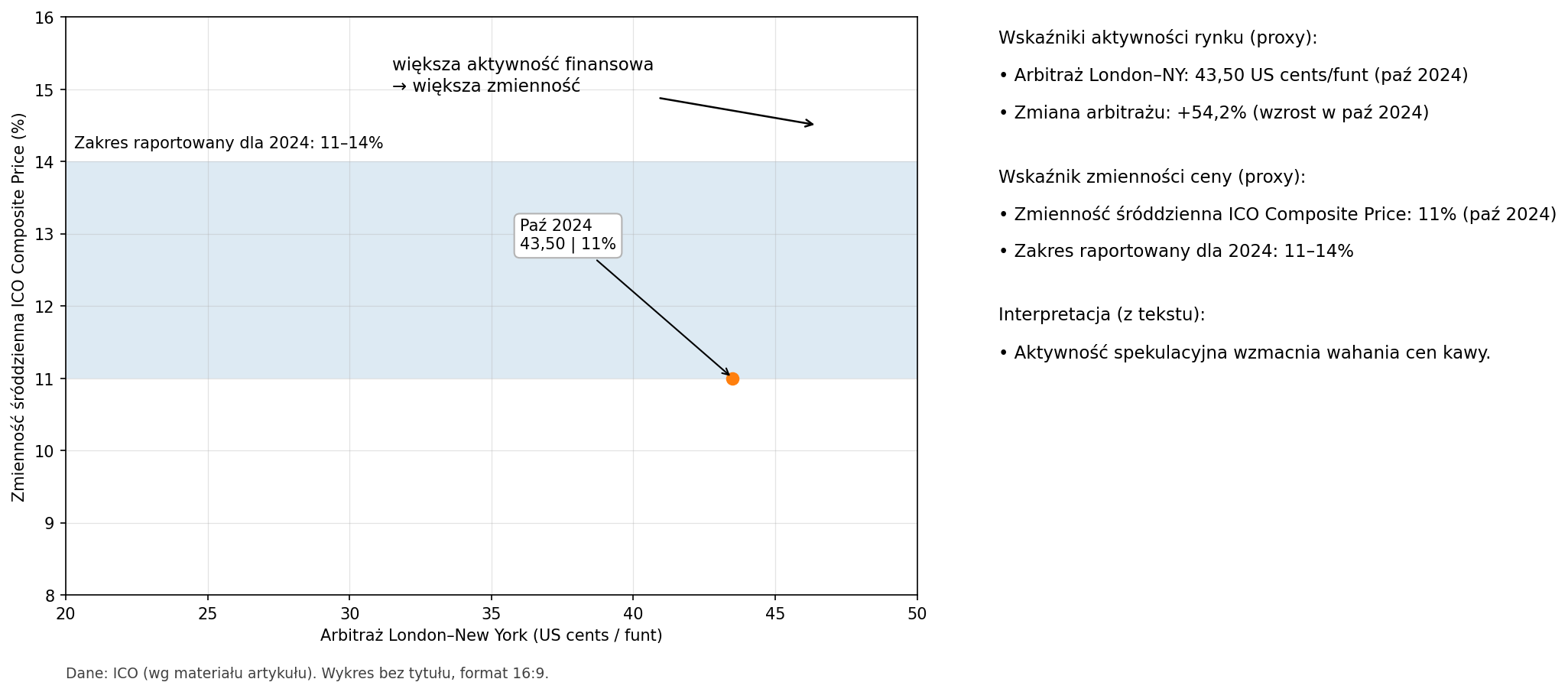
Aktywność rynku a zmienność cen kawy
Perspektywy długoterminowe na lata 2027-2030
Długoterminowa perspektywa dla rynku kawy pozostaje napięta z powodu strukturalnych wyzwań klimatycznych. World Bank ostrzega, że bez adaptacji klimatycznej produkcja kawy będzie ograniczona przez kurczący się areał uprawny. Do 2050 roku 50% obecnych obszarów może stać się nieodpowiednich dla uprawy kawy według prognoz FAO.
Kluczowe trendy długoterminowe:
- Wzrost produkcji w Etiopii - przewidywane rekordowe plony
- Inwestycje w technologie - systemy irygacyjne, odmiany odporne na suszę
- Certyfikacja zrównoważona - rosnące wymagania rynków europejskich i amerykańskich
Prognoza cen kawy na 2027 rok
Rok 2027 rozpocznie się od cen w przedziale 8,65-8,73 USD/kg, z perspektywą stopniowego wzrostu do końca roku. Szczyt cen przewidywany jest w grudniu 2027, kiedy notowania mogą osiągnąć 9,54-9,60 USD/kg. Łączny wzrost w ciągu roku wyniesie około 10%, napędzany strukturalnym deficytem podaży na globalnym rynku.
| Miesiąc |
Cena otwarcia (USD/kg) |
Cena zamknięcia (USD/kg) |
Cena minimalna (USD/kg) |
Cena maksymalna (USD/kg) |
| Styczeń 2027 |
8,65 |
8,73 |
8,65 |
8,73 |
| Luty 2027 |
8,76 |
8,86 |
8,76 |
8,88 |
| Marzec 2027 |
8,87 |
8,91 |
8,87 |
8,91 |
| Kwiecień 2027 |
8,91 |
9,04 |
8,90 |
9,05 |
| Maj 2027 |
9,04 |
9,00 |
8,99 |
9,05 |
| Czerwiec 2027 |
9,01 |
8,99 |
8,98 |
9,02 |
| Lipiec 2027 |
8,99 |
9,08 |
8,98 |
9,09 |
| Sierpień 2027 |
9,10 |
9,35 |
9,10 |
9,35 |
| Wrzesień 2027 |
9,36 |
9,33 |
9,32 |
9,40 |
| Październik 2027 |
9,32 |
9,38 |
9,32 |
9,41 |
| Listopad 2027 |
9,38 |
9,54 |
9,38 |
9,54 |
| Grudzień 2027 |
9,54 |
9,60 |
9,54 |
9,60 |
Prognoza cen kawy na 2028 rok
W 2028 roku ceny kawy będą kontynuować trend wzrostowy, rozpoczynając od poziomu 9,60-9,70 USD/kg. Średnie ceny w ciągu roku ustabilizują się w przedziale 9,85-10,30 USD/kg, z wyraźnym przyspieszeniem wzrostu w drugiej połowie roku. Szczyt notowań przewidywany jest w grudniu na poziomie 10,48-10,55 USD/kg, co oznacza wzrost o około 9% w skali roku.
| Miesiąc |
Cena otwarcia (USD/kg) |
Cena zamknięcia (USD/kg) |
Cena minimalna (USD/kg) |
Cena maksymalna (USD/kg) |
| Styczeń 2028 |
9,61 |
9,70 |
9,60 |
9,70 |
| Luty 2028 |
9,72 |
9,83 |
9,72 |
9,83 |
| Marzec 2028 |
9,83 |
9,85 |
9,82 |
9,86 |
| Kwiecień 2028 |
9,86 |
9,99 |
9,86 |
10,00 |
| Maj 2028 |
9,99 |
9,97 |
9,95 |
10,00 |
| Czerwiec 2028 |
9,96 |
9,93 |
9,93 |
9,97 |
| Lipiec 2028 |
9,94 |
10,05 |
9,94 |
10,05 |
| Sierpień 2028 |
10,06 |
10,31 |
10,05 |
10,31 |
| Wrzesień 2028 |
10,31 |
10,27 |
10,27 |
10,35 |
| Październik 2028 |
10,28 |
10,34 |
10,28 |
10,36 |
| Listopad 2028 |
10,34 |
10,49 |
10,33 |
10,49 |
| Grudzień 2028 |
10,48 |
10,55 |
10,48 |
10,55 |
Prognoza cen kawy na 2029 rok
Rok 2029 przyniesie dalszy wzrost cen z poziomu początkowego 10,56-10,67 USD/kg do szczytowego 11,44-11,51 USD/kg w grudniu. Charakterystyczną cechą tego roku będzie przełamanie bariery psychologicznej 11,00 USD/kg już w sierpniu, co może dodatkowo pobudzić spekulacje finansowe. Łączny wzrost cen w skali roku wyniesie około 8%, z wyraźną tendencją do stabilizacji w drugiej połowie roku na poziomie 11,20-11,40 USD/kg.
| Miesiąc |
Cena otwarcia (USD/kg) |
Cena zamknięcia (USD/kg) |
Cena minimalna (USD/kg) |
Cena maksymalna (USD/kg) |
| Styczeń 2029 |
10,56 |
10,67 |
10,55 |
10,67 |
| Luty 2029 |
10,67 |
10,78 |
10,67 |
10,78 |
| Marzec 2029 |
10,77 |
10,80 |
10,77 |
10,81 |
| Kwiecień 2029 |
10,81 |
10,95 |
10,81 |
10,95 |
| Maj 2029 |
10,95 |
10,91 |
10,90 |
10,95 |
| Czerwiec 2029 |
10,91 |
10,88 |
10,88 |
10,92 |
| Lipiec 2029 |
10,89 |
11,00 |
10,89 |
11,00 |
| Sierpień 2029 |
11,01 |
11,25 |
11,00 |
11,25 |
| Wrzesień 2029 |
11,27 |
11,22 |
11,22 |
11,29 |
| Październik 2029 |
11,23 |
11,29 |
11,23 |
11,31 |
| Listopad 2029 |
11,28 |
11,43 |
11,28 |
11,44 |
| Grudzień 2029 |
11,44 |
11,51 |
11,44 |
11,51 |
Prognoza cen kawy na 2030 rok
W 2030 roku ceny kawy osiągną nowe historyczne maksima, rozpoczynając rok na poziomie 11,51-11,61 USD/kg i kończąc w okolicach 12,39-12,46 USD/kg. Wzrost o około 8% w skali roku będzie wynikiem narastającego strukturalnego deficytu podaży związanego ze zmianami klimatycznymi oraz rosnącym globalnym popytem. Przełamanie bariery 12,00 USD/kg nastąpi już w sierpniu, a dalszy wzrost będzie równomiernie rozłożony w czasie, co wskazuje na fundamentalny charakter trendu wzrostowego.
| Miesiąc |
Cena otwarcia (USD/kg) |
Cena zamknięcia (USD/kg) |
Cena minimalna (USD/kg) |
Cena maksymalna (USD/kg) |
| Styczeń 2030 |
11,51 |
11,61 |
11,51 |
11,61 |
| Luty 2030 |
11,62 |
11,72 |
11,62 |
11,73 |
| Marzec 2030 |
11,72 |
11,75 |
11,72 |
11,76 |
| Kwiecień 2030 |
11,75 |
11,91 |
11,75 |
11,91 |
| Maj 2030 |
11,91 |
11,85 |
11,84 |
11,91 |
| Czerwiec 2030 |
11,86 |
11,83 |
11,83 |
11,87 |
| Lipiec 2030 |
11,83 |
11,95 |
11,83 |
11,95 |
| Sierpień 2030 |
11,95 |
12,19 |
11,95 |
12,19 |
| Wrzesień 2030 |
12,22 |
12,18 |
12,17 |
12,25 |
| Październik 2030 |
12,19 |
12,24 |
12,19 |
12,26 |
| Listopad 2030 |
12,23 |
12,38 |
12,23 |
12,39 |
| Grudzień 2030 |
12,39 |
12,46 |
12,38 |
12,46 |
Wnioski: Jak radzić sobie z niepewną przyszłością kawy
Rynek kawy przechodzi transformację napędzaną zmianami klimatycznymi. Brazylia i Wietnam, producenci 60% światowej kawy, zmierzą się z długoterminowymi wyzwaniami wymagającymi wieloletnich inwestycji. ICO raportuje, że w 2025 roku ceny osiągnęły w listopadzie szczyt na poziomie 7,29 USD/kg (+22,1% r/r), najwyższy poziom nominalny od kwietnia 1977 roku, po czym skorygowały do 6,72 USD/kg w grudniu (-7,8%).
Najważniejsze wnioski:
- Ceny kawy pozostaną wysokie przez całą dekadę 2026-2030.
- USDA prognozuje zapasy na najniższym poziomie od 24 lat.
- Inwestycje w adaptację klimatyczną są kluczowe dla przyszłej produkcji.
- Konsumenci muszą zaakceptować kawę jako produkt premium.
- Monitorowanie produkcji w Brazylii i Wietnamie jest niezbędne dla prognozowania ruchów cenowych.
Często zadawane pytania
-
Czy kawa podrożeje w 2026?
Tak, prognozy wskazują na wzrost cen arabiki z poziomu 8,05 USD/kg na początku roku do 8,91 USD/kg pod koniec 2026 roku — wzrost o około 10,5%. USDA prognozuje spadek zapasów globalnych do 20,1 mln worków — najniższy poziom od 24 lat, przy rosnącym popycie szczególnie z Chin, które zwiększyły import o 65% r/r.
-
Jakie są prognozy cen kawy na 2027-2030?
Ceny arabiki będą systematycznie rosnąć przez całą dekadę: 2027 rok — średnio 9,37 USD/kg (wzrost 10%), 2028 rok — średnio 10,25 USD/kg (wzrost 9%), 2029 rok — średnio 11,29 USD/kg (wzrost 8%), 2030 rok — średnio 12,24 USD/kg (wzrost 8%). Szczyt w grudniu 2030 roku osiągnie 12,68-12,77 USD/kg, co stanowi prawie dwukrotny wzrost w porównaniu z początkiem 2026 roku.
-
Co dalej z ceną kawy na giełdzie?
Giełda ICE w grudniu 2025 zanotowała arabikę na poziomie 7,83-8,42 USD/kg, a prognozy na 2026 rok wskazują na dalszy wzrost do 7,94-8,82 USD/kg. Analitycy przewidują kontynuację trendu wzrostowego z możliwością osiągnięcia 8,89-8,97 USD/kg na początku 2027 roku, napędzanego strukturalnym deficytem podaży i rekordowo niskimi zapasami globalnymi.
-
Czy prognozowane są spadki cen kawy?
Niewielkie korekty cenowe możliwe są w maju-czerwcu 2026 roku, kiedy ceny mogą spaść do 8,27-8,29 USD/kg z poziomu 8,33 USD/kg w kwietniu. Jednak są to jedynie krótkoterminowe korekty w ramach długoterminowego trendu wzrostowego — już w lipcu 2026 przewidywany jest powrót do 8,38 USD/kg i dalszy wzrost do końca roku.
-
Kiedy możemy spodziewać się stabilizacji cen kawy?
Stabilizacja może nastąpić w latach 2028-2029, gdy odbudowa produkcji w Wietnamie (prognoza 31 mln worków) i wzrost w Etiopii zaczną równoważyć rynek.
-
Ile kosztuje kawa w kawiarni w 2026?
FAO raportuje, że konsumenci w USA płacą o 6,6% więcej, a w UE o 3,75% więcej niż rok temu. W Polsce cena espresso może wzrosnąć do 15-18 PLN, a cappuccino do 18-22 PLN w 2026 roku.
-
Jak zmienia się popyt na kawę na świecie?
Globalny popyt rośnie mimo wysokich cen. Brazylia zwiększyła eksport do Chin o 65%, Kolumbia o 246%. Chiny podpisały umowę o wartości 500 mln USD z Luckin Coffee, co potwierdza silny wzrost popytu azjatyckiego.
-
Jaka jest rola rynków finansowych w kształtowaniu cen kawy?
Rynki finansowe znacząco amplifikują zmienność — w grudniu 2025 ICO Composite Price spadła z 7,58 USD/kg do 6,24 USD/kg w ciągu zaledwie dwóch tygodni (-17,7%) po ogłoszeniu lepszych prognoz zbioru w Brazylii. Prognozowana zmienność śróddzienna w 2026 roku utrzyma się na poziomie 12-15%, a intensywna aktywność spekulacyjna funduszy hedgingowych będzie nadal wpływać na gwałtowne wahania cen niezależnie od rzeczywistego popytu fizycznego.
-
Jak zmiany cen kawy wpłyną na kawiarnie i restauracje w Polsce?
Polskie kawiarnie zmierzą się ze wzrostem kosztów surowca o 40-50% według ICO. Część lokali przerzuci koszty na konsumentów, inne zmniejszą marże, co może wpłynąć na kondycję finansową branży gastronomicznej.
-
Czy wzrost cen kawy dotyczy wszystkich rodzajów i marek kawy w tym samym stopniu?
W 2025 roku arabika wzrosła o 6-9% osiągając 7,83-8,42 USD/kg, podczas gdy robusta spadła o 16,7% do 4,21 USD/kg. Jednak prognozy na 2026 pokazują odwrócenie trendu — robusta ma wzrosnąć do 4,41-5,07 USD/kg (+5-21%), podczas gdy arabika osiągnie 7,94-8,82 USD/kg (+1-10%), co oznacza, że kawy instant i komercyjne oparte na robuście mogą podrożeć szybciej niż premium arabika.
-
Jakie alternatywy dla kawy mogą zyskać na popularności w obliczu rosnących cen?
Przy cenach kawy na najwyższych poziomach od dekad, alternatywy jak herbata, yerba mate i napoje energetyczne zyskują popularność. Rozwija się również rynek kaw z zamienników roślinnych, choć pozostają w fazie wczesnego rozwoju.