What is Leverage Trading? Complete Guide to Risks and Mechanics 2026
)
Table of Contents
Leverage Trading Definition and Core Mechanics
How Does Leverage Trading Work: Step-by-Step Mechanics
Leverage Ratios: 10:1, 30:1, and Beyond
Leverage Trading Risks: Margin Calls and Loss Potential
Regulatory Framework and Investor Protection
Leverage Trading Platforms and Broker Selection
Historical Context: Evolution of Leverage Trading
Advanced Leverage Concepts and Strategies
Conclusion: Responsible Approach to Leverage Trading
Frequently Asked Questions About Leverage Trading
Leverage Trading Definition and Core Mechanics
Leverage trading is a financial mechanism where traders use initial capital combined with borrowed funds from brokers to amplify their position size and market exposure. Expressed as ratios like 10:1 or 30:1, leverage allows traders to control larger positions than their account balance would normally permit, but proportionally amplifies both profits and losses.
The fundamental purpose of leverage is position amplification and capital efficiency. When a trader uses 30:1 leverage, every £1,000 of their own capital controls a £30,000 market position. This borrowed capital comes directly from the broker, who charges financing costs and maintains strict margin requirements to protect against losses.
Leverage originated in early 20th century financial markets and became formalized through regulatory frameworks established in 1933. Modern leverage trading operates under heavily regulated conditions, with jurisdiction-dependent limits designed to protect retail investors from excessive risk exposure. Financial authorities including the FCA, ESMA, and CFTC enforce maximum leverage restrictions based on asset classes and trader classification.
The mechanism creates market exposure far exceeding the trader's actual investment. A trader with £5,000 using 50:1 leverage controls £250,000 worth of financial instruments. This amplification works identically for gains and losses—a 2% favorable market movement generates £5,000 profit (100% return), while a 2% adverse movement wipes out the entire account balance.
The Fundamental Risk Warning
Leverage trading carries substantial risk of losses exceeding initial investment. Regulatory authorities require brokers to provide comprehensive risk disclosures acknowledging that leverage can result in rapid and total capital loss. Even with maximum leverage limits implemented by regulators, traders face the possibility of losing more than their deposited funds during extreme market volatility.
The risk amplification inherent in leverage means that small adverse market movements trigger disproportionately large losses. A position using 100:1 leverage requires only a 1% adverse price movement to eliminate the entire account balance, potentially triggering margin calls that demand immediate additional funding. Brokers must issue mandatory warnings that leverage trading is unsuitable for investors unable to sustain substantial financial losses.
Regulatory disclosure requirements emphasize that past performance offers no guarantee of future results, and leveraged positions can move against traders faster than they can respond. Total loss scenarios occur regularly in leveraged trading, particularly during gap openings following weekend closures or major economic announcements that create sudden price movements exceeding stop-loss protections.
How Does Leverage Trading Work: Step-by-Step Mechanics
Step 1: Account Opening and Initial Capital Deposit
The leverage trading process begins when a trader opens an account with a regulated broker offering leverage facilities. The trader deposits initial capital—their own funds that serve as the amplification base for all leveraged positions. Minimum threshold requirements vary by jurisdiction and account type:
- Standard accounts: £100-£500 minimum
- Professional accounts: £5,000-£10,000 minimum
- Institutional accounts: £25,000+ minimum
Step 2: Selecting Your Leverage Ratio
When placing a trade, the trader selects their desired leverage ratio from broker-provided options. Common ratios include:
| Leverage Ratio |
Position Amplification |
Required for Total Loss |
| 10:1 |
£1 controls £10 |
10% adverse movement |
| 20:1 |
£1 controls £20 |
5% adverse movement |
| 30:1 |
£1 controls £30 |
3.33% adverse movement |
| 50:1 |
£1 controls £50 |
2% adverse movement |
Available ratios depend on regulatory limits and asset classes.
Step 3: Position Size Calculation
The broker multiplies your initial capital by the chosen leverage ratio to determine maximum position size:
Formula: Position Size = Initial Capital × Leverage Ratio
Example:
- Initial Capital: £2,000.
- Leverage Ratio: 30:1.
- Position Size: £2,000 × 30 = £60,000.
- Borrowed Capital: £58,000 (provided by broker).
The broker provides the £58,000 difference as borrowed capital, securing this loan against your account balance.
Step 4: Market Exposure and P&L Amplification
Market exposure created through amplification means you experience profit and loss movements as if you invested the full position size:
| Market Movement |
Position Value Change |
Your P&L |
% of Initial Capital |
| +1% |
+£600 |
+£600 |
+30% |
| -1% |
-£600 |
-£600 |
-30% |
| +2% |
+£1,200 |
+£1,200 |
+60% |
| -2% |
-£1,200 |
-£1,200 |
-60% |
This proportional amplification applies regardless of position direction or market conditions.
Step 5: Continuous Margin Monitoring
Brokers monitor account balances continuously against maintenance margin requirements—the minimum account balance necessary to keep positions open, typically 50-80% of required margin. When your balance falls below this threshold due to adverse market movements, the broker issues a margin call demanding additional funding.
Step 6: Real-Time Collateral Management
The leverage mechanism relies on automated collateral management systems calculating three critical metrics:
| Margin Type |
Definition |
Purpose |
| Available Margin |
Account balance available for opening new positions |
Shows how much more you can trade |
| Used Margin |
Portion currently securing open positions |
Shows capital committed to active trades |
| Free Margin |
Difference between account balance and used margin |
Buffer against adverse movements before margin calls |
Free margin represents your safety buffer—when it approaches zero, margin calls trigger, potentially forcing position liquidation at unfavorable prices.
Key Mechanics Summary
- Your capital gets multiplied by leverage ratio = position size.
- Broker loans the difference as borrowed capital.
- Profit/loss amplifies proportionally to leverage ratio.
- Margin requirements protect broker from losses.
- Margin calls trigger when buffer depletes.
- Automatic systems monitor everything in real-time.
Real-World Leverage Calculation Examples
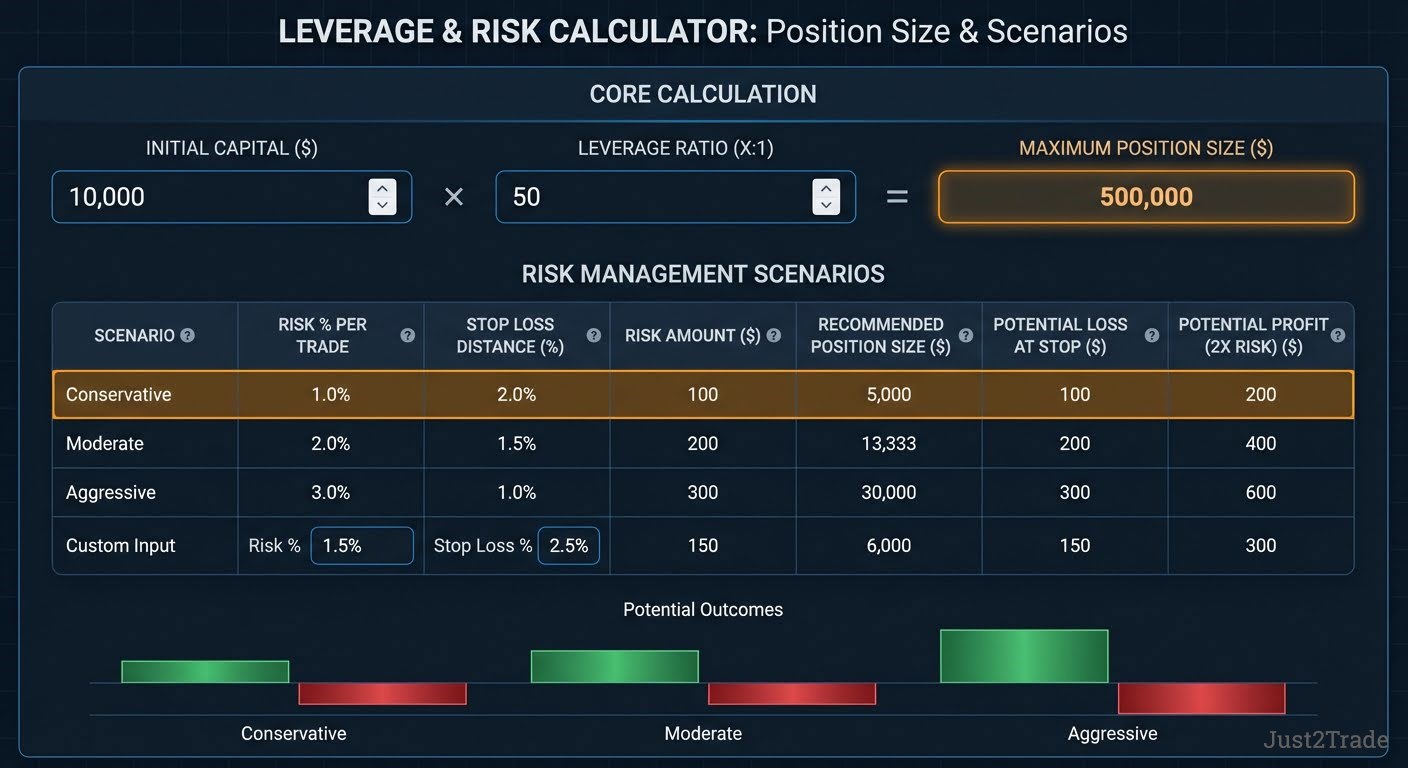)
Consider a trader with £1,000 initial capital choosing 30:1 leverage on a EUR/USD position. The calculation shows: £1,000 × 30 = £30,000 position size. The broker loans £29,000 to create this exposure.
If EUR/USD moves 2% in the trader's favor, the position would show a £600 gain (£30,000 × 0.02), representing a 60% change relative to the £1,000 initial capital. However, actual outcomes depend on execution prices, spreads, financing costs, and market conditions at the time of closing.
Conversely, if EUR/USD moves 2% against the trader, the position loses £600. The account balance drops to £400, triggering margin requirements that may force position closure. The 2% adverse market movement eliminated 60% of initial capital through leverage amplification.
Higher leverage ratios accelerate this risk-reward dynamic. Using 50:1 leverage, the same trader controls £50,000 with £1,000 capital. A 1% adverse movement generates £500 loss—50% of the account. A 2% adverse movement exceeds the initial capital, potentially creating negative balance scenarios requiring additional funds beyond the original investment.
A practical example with major currency pairs demonstrates regulatory limits in action. Under ESMA rules, retail traders in the EU face 30:1 maximum leverage on major pairs like EUR/USD. A trader with £3,000 can control up to £90,000. If the position moves 3.33% against them (approximately 333 pips on a standard lot), their account balance falls to zero, triggering automatic liquidation.
Leverage Ratios: 10:1, 30:1, and Beyond
Leverage ratios represent the relationship between position size and initial capital, expressed in standardized multipliers. Common ratios available from regulated brokers include 10:1, 20:1, 30:1, 50:1, and 100:1, with some jurisdictions permitting even higher ratios for professional traders or specific asset classes.
- The 10:1 ratio is considered conservative in leveraged trading. Every £1,000 controls £10,000 of market exposure. This ratio requires a 10% adverse market movement to eliminate the account balance, providing substantial buffer against typical daily price fluctuations. Regulators often set 10:1 as the maximum for highly volatile assets.
- The 30:1 ratio represents the maximum permitted for retail traders in EU and UK jurisdictions on major currency pairs. This ratio became standard following ESMA's 2018 leverage restrictions designed to reduce retail trader losses. A 30:1 ratio requires only a 3.33% adverse movement to trigger total loss, significantly increasing risk compared to conservative ratios.
- The 50:1 ratio is permitted in some jurisdictions including the United States for forex trading, though regulatory authorities continue debating whether this level provides adequate investor protection. Professional traders and institutions may access 50:1 on specific instruments, but must demonstrate sufficient experience and capital to sustain potential losses.
- Ratios of 100:1 or higher exist primarily in less regulated jurisdictions or for professional classifications. These extreme ratios require only 1% adverse movements for total loss, creating scenarios where positions can be liquidated within minutes during volatile market conditions. Major regulatory bodies including the FCA and CFTC explicitly warn that ratios above 50:1 present unacceptable risk for most traders.
Risk amplification scales proportionally with ratio size. A 2% market movement generates these returns/losses across different ratios:
| Leverage Ratio |
Position Size (£1,000 capital) |
2% Movement Impact |
% Account Impact |
| 10:1 |
£10,000 |
±£200 |
±20% |
| 30:1 |
£30,000 |
±£600 |
±60% |
| 50:1 |
£50,000 |
±£1,000 |
±100% |
| 100:1 |
£100,000 |
±£2,000 |
±200% |
Choosing Appropriate Leverage Levels
- Leverage selection must align with account size, experience level, and risk tolerance. Regulatory frameworks distinguish between retail and professional traders precisely because higher leverage ratios require sophisticated risk management capabilities most beginners lack.
- Regulatory frameworks distinguish between retail and professional traders based on experience and capital requirements. The choice of leverage ratio is a personal decision that should reflect individual risk tolerance, financial capacity to sustain losses, and trading experience. Those new to leveraged trading should understand that higher ratios amplify both potential gains and losses proportionally. Professional financial advice should be sought before determining appropriate leverage levels for individual circumstances.
- Account size influences appropriate leverage through margin requirement calculations. Larger accounts can afford the same position sizes at lower leverage ratios, reducing risk amplification while maintaining desired market exposure. A trader with £10,000 using 10:1 leverage achieves the same £100,000 position size that a £3,000 account requires 33:1 leverage to reach.
- Experience requirements for higher ratios include understanding of margin calls, position liquidation procedures, correlation risk across multiple leveraged positions, and ability to monitor markets continuously during volatile periods. Professional trader classifications in jurisdictions like the UK require demonstrating these competencies plus sufficient capital reserves.
Leverage Trading Risks: Margin Calls and Loss Potential
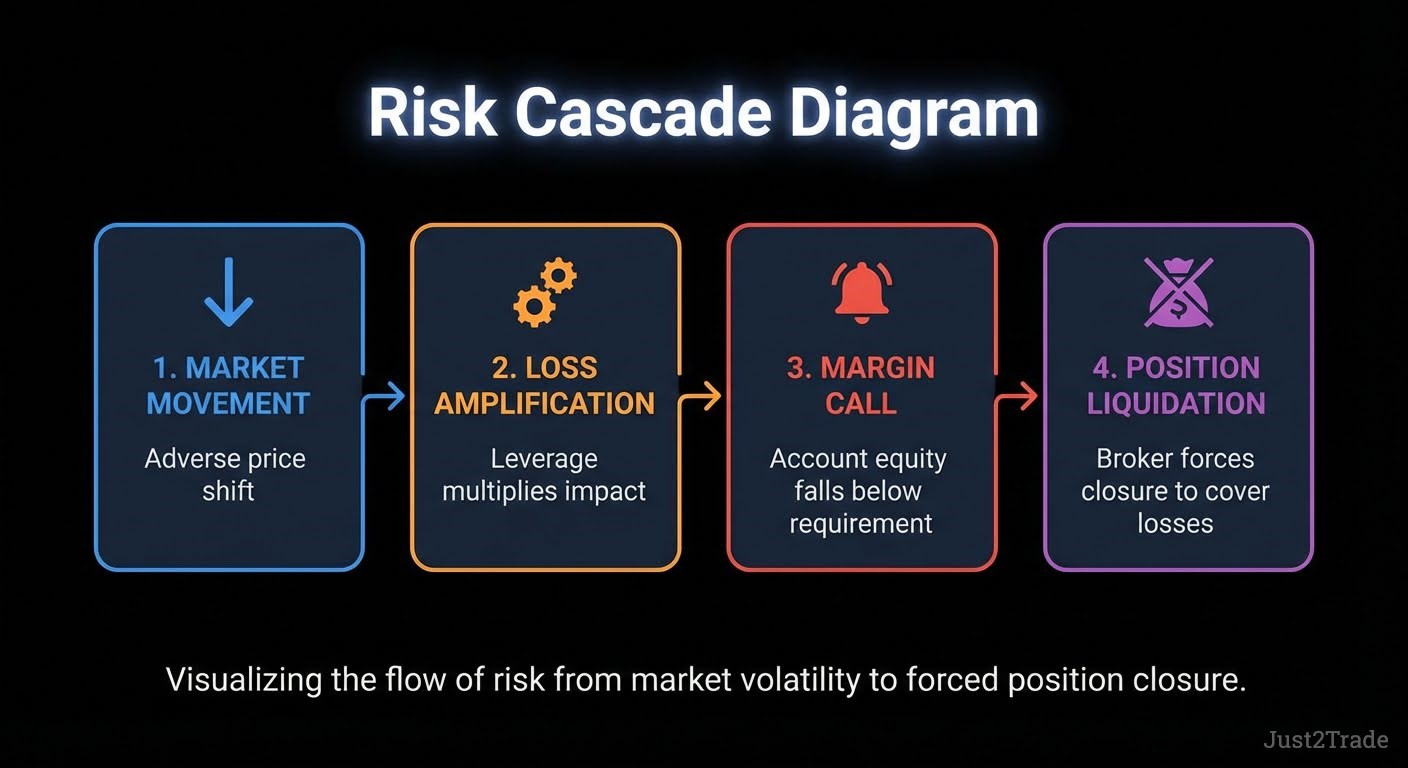)
Margin calls represent the critical risk mechanism in leveraged trading. When account balance falls below maintenance margin requirements due to adverse market movements, brokers issue margin calls demanding additional fund deposits within strict time constraints. Failure to meet these demands results in automatic position liquidation, often at unfavorable prices that compound losses.
The trigger mechanism operates through continuous account balance monitoring against used margin calculations. Most brokers set maintenance margin at 50-80% of required margin for opening positions. Once this threshold is breached, traders typically receive 24-72 hours to deposit additional funds, though some brokers liquidate positions immediately during extreme volatility.
Loss amplification through leverage creates risk cascade scenarios. A trader with £5,000 using 50:1 leverage on a £250,000 position experiences £2,500 loss from just a 1% adverse movement. This reduces account balance to £2,500, triggering margin call requirements. If the market continues moving adversely before additional funds arrive, automatic liquidation occurs at the current unfavorable price, potentially exceeding the original £5,000 investment.
Position liquidation consequences extend beyond immediate financial loss. Forced closures typically occur at bid-ask spreads wider than normal trading conditions, adding transaction costs to existing losses. During gap openings—price jumps between trading session closes and opens—positions may be liquidated at prices significantly worse than stop-loss orders specified, potentially creating negative account balances requiring payment beyond initial capital.
The risk of losses exceeding initial investment remains real despite regulatory negative balance protection requirements in some jurisdictions. Extreme market events including flash crashes, currency devaluations, or unexpected central bank interventions can move prices so rapidly that broker systems cannot close positions before accounts go negative. Swiss franc movements in January 2015 created such conditions, leaving many leveraged traders owing brokers substantial amounts beyond their deposits.
Understanding Margin Call Procedures
Margin calls follow standardized procedures mandated by regulatory frameworks. When account balance falls below maintenance margin threshold, brokers must notify traders through email, SMS, and platform alerts. The notification specifies the required additional fund amount and deadline for deposit.
Time constraints for responding vary by broker and jurisdiction. Most regulated brokers provide 24-48 hours for standard margin calls, though some implement immediate liquidation policies during rapid market movements. Traders should verify their broker's specific margin call procedures in account agreements before opening leveraged positions.
The required action typically involves depositing additional funds equal to or exceeding the margin shortfall, or voluntarily closing positions to reduce used margin below the maintenance threshold. Some brokers allow partial position closures to meet margin requirements without depositing new funds.
Automatic position closure mechanisms activate when deadlines pass without sufficient action. Brokers typically close the largest losing positions first, continuing until maintenance margin requirements are satisfied. This forced liquidation occurs at current market prices regardless of whether those prices represent optimal exit points for the trader's strategy.
The consequences of unmet margin calls extend beyond immediate position loss. Negative account balances created during extreme volatility become debt obligations to the broker. While EU regulations require negative balance protection for retail accounts, this protection isn't universal—traders in some jurisdictions may face legal action for negative balances exceeding £10,000 or more.
Preventing and Managing Leverage Losses
Risk management strategies are tools traders use in attempting to control exposure, but they cannot eliminate the inherent risks of leverage trading or guarantee protection against losses. Position sizing represents the first defense—limiting any single leveraged position to 1-2% of account balance restricts how much a single adverse movement can damage overall capital.
- Stop-loss orders automate position closures when predetermined price thresholds are reached. A trader opening a £50,000 leveraged position with £2,000 capital might set a stop-loss at 1% adverse movement, limiting potential loss to £500. However, stop-losses cannot guarantee execution at specified prices during gaps or extreme volatility.
- Account monitoring practices include regular margin level checks and reducing position sizes before maintenance thresholds approach. Traders should maintain free margin buffers of at least 30-50% of account balance to withstand normal market fluctuations without triggering margin calls.
- Risk limits through maximum daily loss thresholds help prevent emotional decision-making during losing streaks. A disciplined approach might specify closing all positions and ceasing trading for the day after losses reach 5% of account balance.
Even comprehensive risk management cannot eliminate leverage trading's inherent high-risk nature. Unexpected market events including central bank announcements, geopolitical crises, or flash crashes can overwhelm protective measures. Traders must accept that leverage trading carries substantial risk of total capital loss regardless of risk management implementation.
Regulatory Framework and Investor Protection
Financial regulatory authorities worldwide enforce maximum leverage limits designed to protect retail investors from excessive loss exposure.
- The European Securities and Markets Authority (ESMA) implemented comprehensive leverage restrictions in 2018 following statistical evidence that 74-89% of retail leverage trading accounts lost money. ESMA regulations establish tiered maximum leverage ratios based on asset class volatility. Major currency pairs face 30:1 limits, while less liquid currencies receive 20:1 caps. Indices and commodities face 20:1 or 10:1 limits depending on liquidity.
- The Financial Conduct Authority (FCA) in the UK maintains similar restrictions post-Brexit, keeping 30:1 maximum leverage on major pairs for retail traders while allowing professional classifications to access higher ratios. Professional status requires demonstrating at least two of: £500,000+ portfolio value, 10+ leveraged trades quarterly for four consecutive quarters, or relevant financial industry employment.
- The Commodity Futures Trading Commission (CFTC) in the United States sets 50:1 maximum leverage for major currency pairs and 20:1 for less liquid currencies. US regulations additionally require registration of forex brokers as Futures Commission Merchants, creating oversight mechanisms that enforce capital adequacy requirements and customer fund segregation.
Protection measures mandated by regulators extend beyond leverage limits. Negative balance protection requirements in EU jurisdictions prevent retail traders from losing more than their deposited funds during most market conditions. Brokers must absorb losses exceeding account balances rather than pursuing traders for additional payments.
Compliance requirements for brokers include prominent risk disclosure statements, margin call notification procedures, and restrictions on marketing materials. ESMA rules prohibit promotional bonuses that might encourage excessive risk-taking, while FCA standards require brokers to assess client appropriateness before allowing leveraged trading.
Risk disclosure mandates specify exact warning language that must appear on all marketing materials and account opening documentation. Typical disclosures state: "CFDs are complex instruments and come with a high risk of losing money rapidly due to leverage. [X]% of retail investor accounts lose money when trading CFDs with this provider. You should consider whether you understand how CFDs work and whether you can afford to take the high risk of losing your money."
Jurisdiction-Specific Leverage Rules
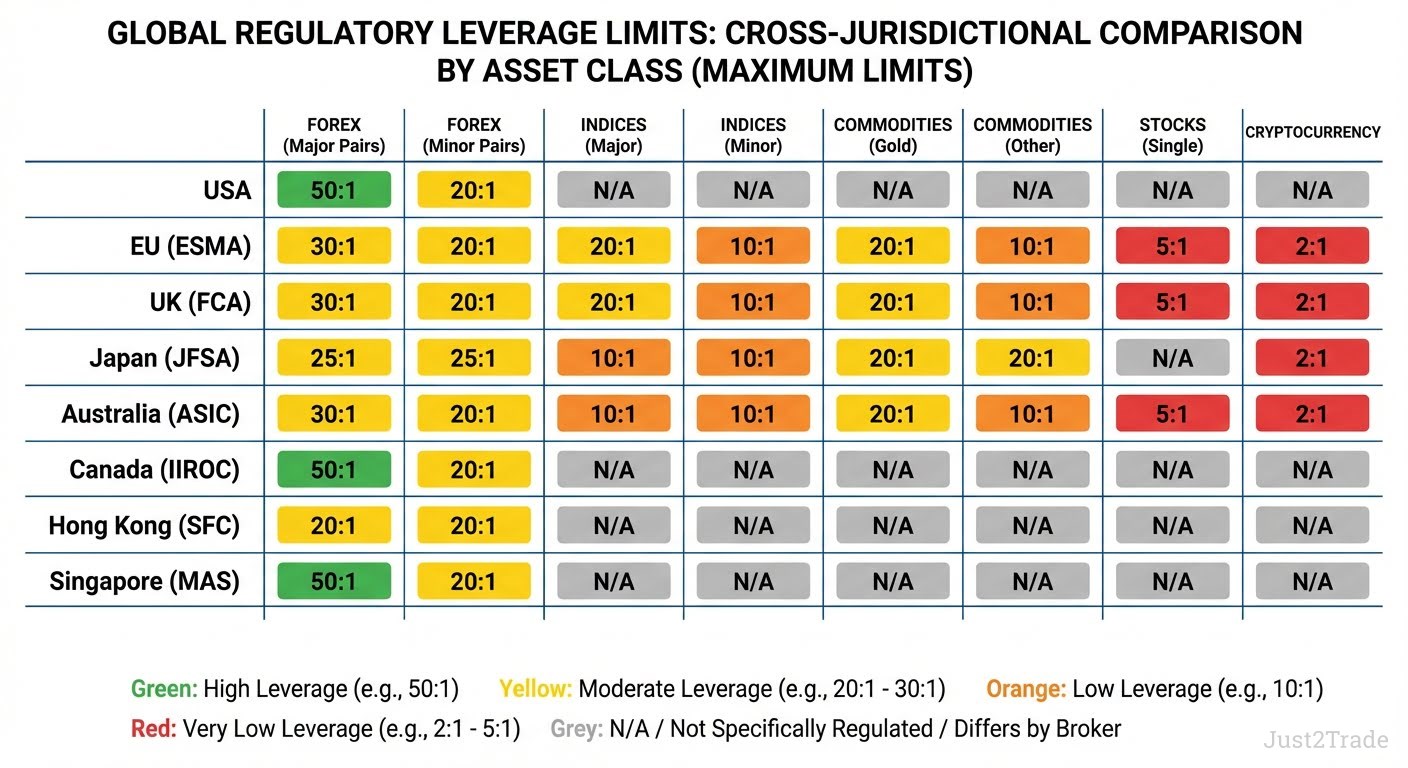)
- European Union leverage regulations under ESMA apply across all 27 member states, creating harmonized maximum limits: 30:1 for major currency pairs, 20:1 for non-major pairs and gold, 10:1 for commodities and indices, 5:1 for individual equities.
- United Kingdom rules mirror EU standards despite Brexit, maintaining 30:1 retail limits while the FCA continues evaluating whether further restrictions are necessary. UK brokers must additionally participate in the Financial Services Compensation Scheme, protecting up to £85,000 per trader if the broker becomes insolvent.
- United States regulations through the CFTC permit 50:1 leverage on major pairs—higher than EU/UK standards—but impose stricter broker capital requirements and registration processes. The National Futures Association (NFA) audits member brokers quarterly to verify compliance with leverage limits and customer fund segregation rules.
- Australia's Securities and Investments Commission (ASIC) reduced maximum leverage from 500:1 to 30:1 for major pairs in 2021, aligning with international standards after identifying widespread retail trader losses. ASIC rules additionally require brokers to report quarterly statistics on profitable versus losing client accounts.
Regulatory differences create jurisdiction shopping behavior where traders seek brokers in less regulated regions offering higher leverage. However, such brokers often lack investor protection mechanisms including negative balance protection, compensation schemes, or effective complaint resolution procedures.
Leverage Trading Platforms and Broker Selection
Platform features essential for leveraged trading include real-time margin level displays, automated margin call notifications, and negative balance protection where mandated. Quality platforms show available margin, used margin, and free margin updated continuously, enabling traders to monitor proximity to margin call thresholds.
Regulatory compliance verification forms the foundation of broker selection. Traders should confirm broker registration with relevant authorities: FCA registration numbers in the UK, NFA membership in the US, or CySEC licensing in Cyprus. Regulatory websites provide public registries showing broker status and any enforcement actions or fines.
Risk disclosure quality varies significantly between brokers despite regulatory requirements. Superior brokers provide detailed educational materials explaining leverage mechanics, margin call procedures, and specific loss scenarios. They display actual statistics showing what percentage of their retail accounts lose money when trading with leverage.
Margin management systems differ in sophistication and trader control. Some brokers implement automatic position closure at 50% margin level, while others allow traders to set custom margin call thresholds. The best platforms provide hierarchical liquidation options, letting traders specify which positions should close first during margin calls.
Customer fund segregation represents critical protection against broker insolvency. Regulated brokers must maintain client funds in separate accounts from operating capital, ensuring deposits remain available even if the broker fails. FCA rules require UK brokers to segregate funds in major UK banks and participate in compensation schemes.
Essential Platform Risk Management Features
- Take-profit automation complements stop-loss functionality by closing positions automatically when specified price levels are reached. This tool is designed to execute pre-planned exit strategies, though it cannot guarantee profits or prevent losses during volatile market conditions or gaps.
- Margin monitoring alerts provide SMS, email, or push notifications when account margin levels approach dangerous thresholds. Traders can configure alerts at 70%, 60%, and 50% margin levels, providing early warning before forced liquidation occurs.
- Account protection measures in quality platforms include negative balance protection (where mandated), guaranteed stop-loss orders for premium fees, and maximum exposure limits preventing traders from opening positions exceeding their risk tolerance settings.
- Take-profit automation complements stop-loss functionality by closing positions automatically when profit targets are reached. This removes emotional decision-making from profitable trades, ensuring gains are realized before market reversals eliminate them.
- Correlation analysis tools help advanced traders identify when multiple leveraged positions create compounded risk exposure. If three separate positions all correlate positively, their combined risk exceeds the sum of individual positions—a dangerous scenario during market events affecting correlated assets simultaneously.
Historical Context: Evolution of Leverage Trading
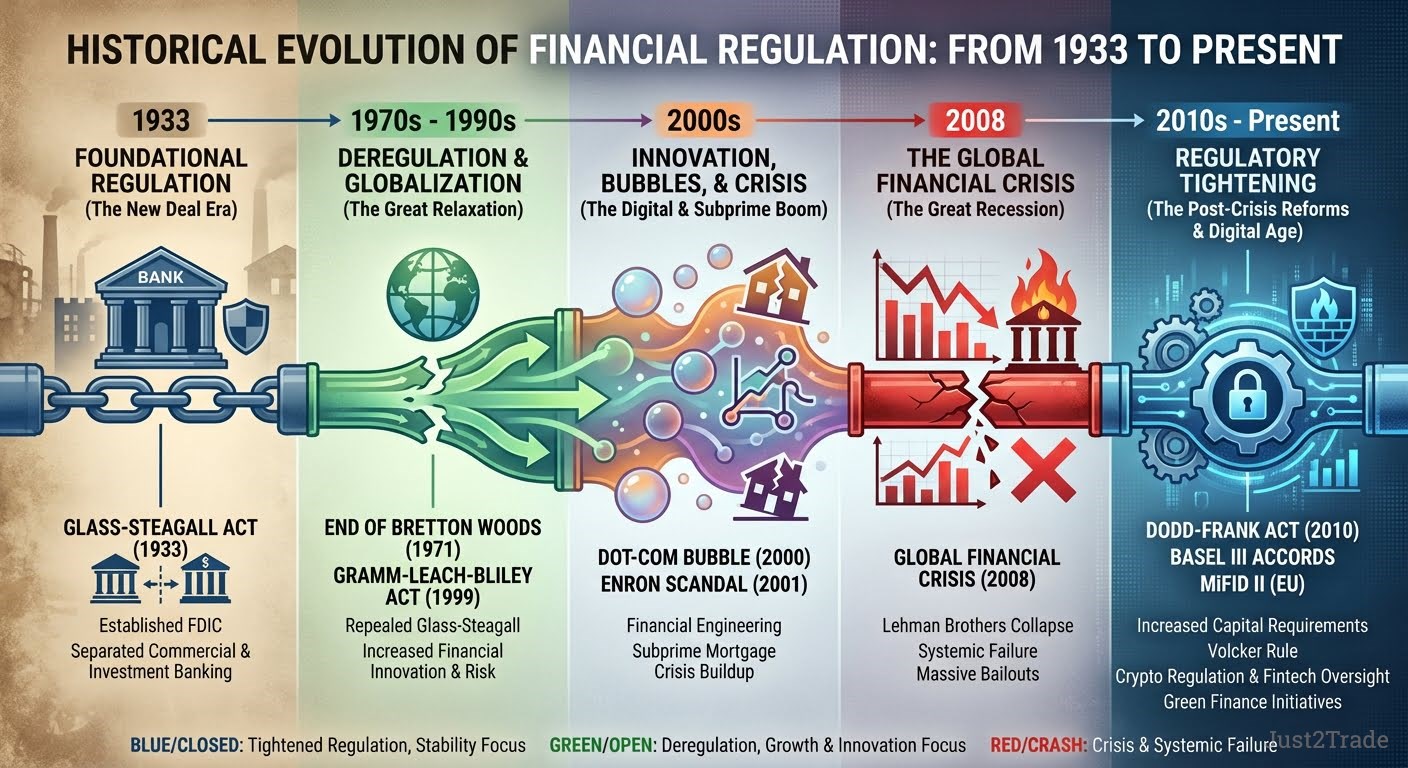
Leverage trading mechanisms emerged in early 20th century financial markets as brokers developed margin account systems allowing investors to borrow funds for larger market positions. Initial implementations lacked regulatory oversight, contributing to the speculative bubbles preceding the 1929 stock market crash.
The Securities Exchange Act of 1933 in the United States represented the first major regulatory framework governing leverage and margin requirements. This legislation established the Securities and Exchange Commission (SEC) and empowered it to set maximum leverage ratios, initially limiting stock purchases to 50% margin—equivalent to 2:1 leverage.
Forex leverage trading developed separately through over-the-counter currency markets in the 1970s following the collapse of the Bretton Woods system. Early forex brokers offered leverage ratios exceeding 200:1 with minimal oversight, creating substantial retail trader losses that eventually prompted regulatory intervention.
The 1990s and early 2000s saw explosive growth in retail leveraged trading as internet platforms democratized access to markets previously limited to institutional participants. Brokers competed by offering increasingly high leverage ratios—some reaching 500:1 or even 1000:1—with inadequate risk disclosures.
Regulatory tightening began following the 2008 financial crisis when authorities recognized that excessive leverage contributed to systemic risk and widespread retail investor losses. The Dodd-Frank Act in the US reduced forex leverage to 50:1 in 2010, representing the first major retail protection measure.
ESMA's 2018 leverage restrictions marked the most comprehensive regulatory intervention to date. Following analysis showing 74-89% of retail CFD accounts lost money, ESMA implemented strict leverage caps, negative balance protection, and mandatory risk disclosure percentages across all EU member states.
Current regulatory evolution trends toward further restrictions as authorities accumulate additional evidence of retail trader losses. The FCA continues reviewing whether 30:1 leverage remains appropriate, while ASIC and other international regulators consider following ESMA's model with even stricter limits on leverage.
Advanced Leverage Concepts and Strategies
Advanced leverage management requires understanding multiple risk dimensions beyond basic ratio calculations. The table below outlines key concepts professional traders use to navigate leveraged positions:
| Concept |
Description |
Practical Application |
Risk Consideration |
| Duration Risk |
Overnight financing charges accumulate daily on borrowed capital, eroding returns over extended holding periods |
Position held 30 days at 5% annual financing costs reduces returns by ~0.4%—significant when leverage amplifies small percentage movements |
Long-term leveraged positions face compounding financing costs that can eliminate profits even during favorable market movements |
| Correlation Risk |
Multiple leveraged positions on related assets create compounded exposure during market events |
Trader with three 30:1 positions on EUR/USD, GBP/USD, AUD/USD faces combined risk exceeding individual positions when USD moves |
Major currency movements impact all correlated pairs simultaneously, potentially triggering multiple margin calls |
| Strategic vs Tactical Leverage |
Distinction between consistent position sizing leverage and opportunistic high-ratio trades |
Institutional traders maintain 5:1-10:1 average ratios, deploying higher ratios only for specific high-conviction setups with tight stop-losses |
Tactical leverage requires superior timing and risk management—errors at high ratios create rapid catastrophic losses |
| Volatility-Adjusted Leverage |
Reducing leverage ratios during high-volatility periods and increasing during stable markets |
30:1 position during 1% daily volatility presents different risk than same ratio during 3% daily volatility |
Failure to adjust for volatility changes can result in unexpected margin calls during market regime shifts |
| Portfolio vs Position Leverage |
Overall account leverage may differ from individual trade leverage |
Trader uses 10:1 on individual positions while maintaining 5:1 portfolio leverage by keeping capital reserves |
Provides buffers against simultaneous adverse movements but reduces capital efficiency |
| Hedging with Leverage |
Using leveraged short positions to offset leveraged long positions in correlated assets |
Offsetting EUR/USD long with GBP/USD short during correlated market conditions |
Correlation breakdown during extreme events transforms hedges into additional risk sources |
| Advanced Risk Metrics |
Quantitative tools for measuring leveraged position exposure |
Value at Risk (VaR) calculations, stress testing vs historical extremes, scenario analysis across market conditions |
No metric eliminates leverage's fundamental risk—models fail during unprecedented market events |
Conclusion: Responsible Approach to Leverage Trading
Leverage trading fundamentally amplifies both trading opportunities and risks of substantial loss. While leverage ratios from 10:1 to 30:1 create potential for significant returns from modest market movements, they equally magnify losses that can eliminate entire account balances within minutes during adverse price movements.
Regulatory protection measures including maximum leverage limits, negative balance protection, and mandatory risk disclosures provide important safeguards, but cannot eliminate the inherent high-risk nature of leveraged trading. Statistical evidence from major regulators consistently shows that 70-80% or more of retail leverage trading accounts lose money, demonstrating that most participants cannot profitably manage the risks despite regulatory protections.
Leverage trading involves understanding margin call procedures, position liquidation mechanisms, and scenarios where small adverse movements can trigger substantial losses. Anyone considering leverage trading should carefully evaluate whether they have sufficient capital to sustain potential losses, understand the mechanisms involved, and recognize that leverage trading may not be suitable for their circumstances. Professional financial advice should be obtained before engaging in leveraged trading activities.
The fundamental principle remains: leverage trading is unsuitable for investors unable to afford substantial financial losses. The amplification of market exposure that creates profit potential operates identically for losses, with no mechanism distinguishing between favorable and unfavorable market movements. Comprehensive risk assessment must precede any leveraged trading activity, with clear acceptance that total capital loss represents a realistic outcome regardless of experience level or strategy sophistication.
Frequently Asked Questions About Leverage Trading
FAQ
-
What's the difference between 10:1 and 30:1 leverage?
The ratio indicates amplification factor—10:1 means every £1 controls £10 of market exposure, while 30:1 means every £1 controls £30. A 10:1 position requires 10% adverse movement for total loss, while 30:1 requires only 3.33% adverse movement. Higher ratios amplify both profits and losses proportionally, creating faster path to margin calls and position liquidation during unfavorable market movements.
-
How much money do you need to start leverage trading?
Minimum deposit requirements vary by broker and jurisdiction, typically ranging from £100 to £500 for retail accounts. The amount of capital needed depends on individual financial circumstances, risk tolerance, and ability to sustain potential losses. Any amount invested in leverage trading should be capital you can afford to lose entirely. Individuals should consult with a qualified financial advisor to determine if leverage trading is appropriate for their financial situation and, if so, what capital allocation would be suitable.
-
Can leverage trading be profitable for beginners?
Statistical evidence from regulators consistently shows 70-80% of retail leverage trading accounts lose money, with beginners facing even higher loss rates. Leverage amplifies both potential gains and losses equally. The complexity of leveraged trading requires understanding of risk management, market analysis, and disciplined execution that takes considerable time to develop. Individuals considering leverage trading should carefully assess their financial situation, risk tolerance, and whether they can afford to lose their invested capital. Consulting with a qualified financial advisor is strongly recommended before engaging in leveraged trading activities.
-
What assets can you trade with leverage?
Regulated brokers offer leverage on major currency pairs (30:1 maximum in EU/UK), minor currency pairs (20:1), stock indices (20:1 or 10:1), commodities including oil and gold (10:1), individual equities (5:1). Maximum ratios vary by jurisdiction and asset class volatility, with more volatile assets receiving lower limits.
-
How do brokers make money from leverage trading?
Brokers generate revenue through bid-ask spreads—the difference between buying and selling prices—which remain consistent regardless of leverage used. Additional income comes from overnight financing charges on borrowed capital, typically calculated as percentage of position size and charged daily for positions held beyond market close. Some brokers also charge commission per trade or inactivity fees.
-
Are there alternatives to high-risk leverage trading?
Alternative approaches to financial markets exist with different risk profiles, including unleveraged trading or investment in traditional instruments. Each approach carries its own risks and suitability depends on individual circumstances. Individuals should conduct thorough research and consult with qualified financial advisors to understand which approaches, if any, align with their financial goals, risk tolerance, and personal situation. No investment approach eliminates risk or guarantees returns.
-
What happens if you can't meet a margin call?
Inability to meet margin calls within specified timeframes (typically 24-48 hours) results in automatic position liquidation by the broker. Positions close at current market prices, which may be significantly unfavorable, potentially creating losses exceeding initial account balance. In jurisdictions without negative balance protection, traders may owe additional funds beyond their deposit.
-
How do economic events affect leveraged positions?
Major economic announcements including central bank interest rate decisions, employment reports, or GDP releases create volatility spikes that amplify rapidly through leveraged positions. A news event moving prices 1% generates 30% account impact at 30:1 leverage. Gap openings between trading sessions can bypass stop-loss orders, creating losses substantially exceeding intended risk limits.